
2026 Toyota bZ
 C/D RATING


- AWD models are quick, competitive range figures, faster charging.
- Bland exterior styling, unexciting handling, awkward seating position.
- Toyota's electric SUV now has a less clunky name and benefits from numerous improvements to its powertrain, battery, and charging systems.
For Sale Near You
See all results for new 2026 Toyota bZ for sale near 7004


236–314 Miles

5 Seats

Electric

All-Wheel Drive, Front-Wheel Drive

3 Years/36,000 Miles
Overview
The name "bZ4X" doesn’t exactly roll off the tongue, which is probably one of the reasons that Toyota has renamed its electric compact SUV to just "bZ" for 2026. The bZ's updates go well beyond just its new name, with sizable improvements made to its electric powertrain, charging tech, and interior layout. The bZ is still offered with the choice of front- or all-wheel drive, and both receive a much-needed bump in power. Some FWD models now have 221 horsepower, and the AWD model has 338 horsepower. Combined with higher range capabilities from all-wheel-drive trims and tweaked styling both inside and out, the updated bZ is a more appealing package in both name and capability.
Where This Vehicle Ranks
#8 in Best Electric Compact SUVs


Hyundai Ioniq 5 N10/10
STARTING AT: $68,000
Hyundai Ioniq 510/10
STARTING AT: $36,600
Kia EV69.5/10
STARTING AT: $45,000
Tesla Model Y9/10
STARTING AT: $41,630
Ford Mustang Mach-E8.5/10
STARTING AT: $39,840
Toyota bZ7.5/10
STARTING AT: $36,350Compare the 2026 Toyota bZ with the top vehicles in this segment with our new compare tool.
What's New for 2026?
Thanks to upgraded electric motors, all-wheel-drive variants get a bump to 338 horsepower, up from 215 ponies previously. According to Toyota, range is up by 25 percent compared to the 2025 model, to a claimed 314 miles. A NACS (North American Charging Standard) port replaces the old CCS port, so the bZ can now charge at Tesla Superchargers. The battery pack in the front-wheel-drive XLE model decreases in capacity from 63.4 kWh to 57.7 kWh, while all other models get a new, larger 74.7-kWh pack. Toyota says that the bZ can now charge from 10 to 80 percent in around 30 minutes on a DC fast charger, and the AC charge speed is faster thanks to a higher-capacity 11-kW on-board charger. A new preconditioning system makes sure the battery is at optimum charging temp before you plug in. Styling is updated too, featuring a tweaked front end and a new dashboard design.
 C/D Expert Tip:
If this year's model has no changes, this is your cue to save by looking at cars from previous model years. You can almost always get the features you want for less money by purchasing a one-to-three-year-old model.

 C/D Rating: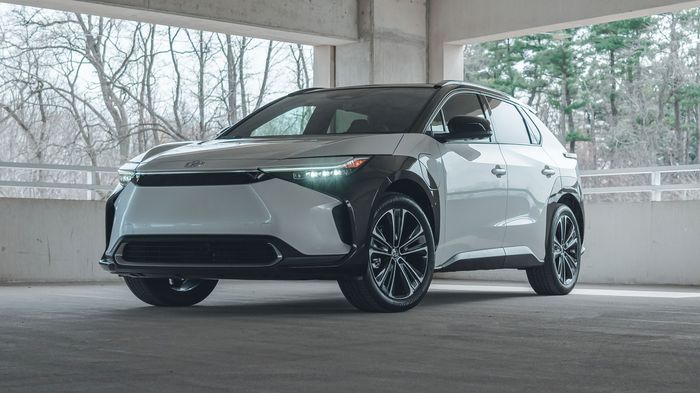

Pricing and Which One to Buy
The front-wheel-drive XLE model is the price leader, and the XLE Plus offers the most range, but we think it's worth it to opt for the XLE AWD with the more powerful dual-motor powertrain. Standard features on the XLE include 18-inch alloy wheels, front and rear ambient lighting, an 8-way power-adjustable driver's seat, 60/40 split folding seats, and heated front seats.
Compare the 2026 Toyota bZ to other vehicles you're interested in
Our new comparison tool provides a comprehensive, side-by-side comparison of up to five vehicles of your choice.
EV Motor, Power, and Performance
The bZ’s comprehensive update includes new electric motors, meaning that some versions of the bZ have a higher power output than they did previously. Front-wheel-drive XLE models come with a 168-hp electric motor, but front-wheel drive XLE Plus and Limited models now produce 221 horsepower from a single electric motor, while their all-wheel-drive counterparts now deliver 338 horsepower from two electric motors located at the front and rear. With this additional get-up-and-go, the bZ now has comparable power to rivals like the Hyundai Ioniq 5 and Volkswagen ID.4. We drove multiple versions of the bZ and came away with the AWD version's increased power output, as it makes the bZ feel a lot quicker and more eager than before. The base model is considerably less quick, but it too has improved ride and handling characteristics when compared with the previous bZ4X.
0–60-MPH Times
We estimate that the all-wheel-drive bZ models will reach 60 mph in around 4.8 seconds, while the front-wheel-drive versions will be slower, reaching 60 mph in over 7.0 seconds. We'll update this section when we have a chance to test the bZ's acceleration capabilities for ourselves.

Range, Charging, and Battery Life
A NACS (North American Charging Standard) port replaces CCS port found in the previous bZ4X, which enables the bZ to charge at Tesla Superchargers. The battery pack in the front-wheel drive XLE model decreases in capacity from 63.4-kWh to 57.7-kWh, which also drops its range to an estimated 236 miles, per Toyota. All other models get a new and larger 74.7-kWh pack, which Toyota estimates will afford 278 miles of range in the AWD Limited, 288 miles in the AWD XLE, 299 miles in the FWD Limited, and 314 miles in the FWD XLE. Toyota says that the bZ can charge from 10 to 80 percent in around 30 minutes on a DC fast charger, and AC charging speed is faster thanks to a higher-capacity 11-kW on-board AC charger.
Fuel Economy and Real-World MPGe
The EPA hasn't yet rated the 2026 bZ, but we estimate it will deliver similar MPGe figures as before. We estimate it will have a combined figure of between 93 and 115 MPGe, depending on configuration. When we get our hands on the bZ, we'll test it on our 75-mph real-world highway fuel-economy test. MPGe stands for miles per gallon of gas equivalent, an EPA metric that estimates PHEV and EV vehicle fuel efficiency.
Interior, Comfort, and Cargo
The bZ has a spacious, airy interior that incorporates a digital gauge display and a 14.0-inch central touchscreen. The 2026 model’s redesigned dashboard is less bulky and improves upon some of the previous model’s odd sightlines and the difficult-to-see gauge display. The wide center console between the front seats features two wireless smartphone charging pads and open storage underneath, although there’s no glovebox. The previous model offered an optional radiant heating element in the lower dash that warms front-seat riders’ legs, but we don’t yet have confirmation that this option is continuing for 2026. We don’t expect the 2026 model’s cargo capacities to change: the bZ has no frunk, and the rear cargo hold volume maxes out at 26 or 28 cubic feet, depending upon the model (versus 38 cubes for the RAV4).

Infotainment and Connectivity
The bZ's infotainment needs are fulfilled by a 14.0-inch display that is operated by a combination of physical and touch controls. Wireless Apple CarPlay and Android Auto come standard, which plays audio through a six-speaker or optional nine-speaker audio system. Two wireless smartphone chargers sit below the central screen.
Safety and Driver-Assistance Features
The bZ comes standard with a comprehensive suite of driver-assistance features, and the Limited trim level offers optional extras including lane-change assist and a Traffic Jam Assist system that allows you to take your hands off the wheel in certain circumstances. For more information about the bZ4X's crash-test results, visit the National Highway Traffic Safety Administration (NHTSA) and Insurance Institute for Highway Safety (IIHS) websites. Key safety features include:
- Standard automated emergency braking with pedestrian detection
- Standard lane departure warning with lane-keeping assist
- Standard adaptive cruise control
Warranty and Maintenance Coverage
Toyota matches what its competitors offer, but it provides above-average coverage when it comes to complimentary maintenance. Likewise, its electrical component warranty is at industry-standard levels.
- Limited warranty covers three years or 36,000 miles
- Powertrain warranty covers five years or 60,000 miles
- Electrical components are covered for eight years or 100,000 miles
- Complimentary maintenance is covered for two years or 25,000 miles

Specifications
Specifications
2026 Toyota bZ
Vehicle Type: front- or front- and mid-motor, front- or all-wheel-drive, 5-passenger, 4-door wagon
BASE PRICE (C/D EST)
XLE, $42,000; Limited, $46,000
POWERTRAIN (FWD)
Motor: permanent-magnet synchronous AC, 168 or 221 hp
Battery Pack: liquid-cooled lithium-ion, 52 or 67 kWh (C/D est)
Onboard Charger: 11.0 kW
Peak DC Fast-Charge Rate: 150 kW
Transmission: direct-drive
POWERTRAIN (AWD)
Front Motor: permanent-magnet synchronous AC
Rear Motor: permanent-magnet synchronous AC
Combined Power: 338 hp
Battery Pack: liquid-cooled lithium-ion, 67 kWh (C/D est)
Onboard Charger: 11.0 kW
Peak DC Fast-Charge Rate: 150 kW
Transmissions, F/R: direct-drive
DIMENSIONS
Wheelbase: 112.2 in
Length: 184.6 in
Width: 73.2 in
Height: 65.0 in
Passenger Volume, F/R: 54/40 ft3
Cargo Volume: 26–28 ft3
Curb Weight (C/D est): 4100–4500 lb
PERFORMANCE (C/D EST)
60 mph: 4.8–7.8 sec
1/4-Mile: 12.8–16.2 sec
100 mph: 13.0–19.5 sec
Top Speed: 110 mph
EPA FUEL ECONOMY (C/D EST)
Combined/City/Highway: 93–115/95–100/85–105 MPGe
Range: 235–314 mi
Shopping Tools
Similar Vehicles
2026 Hyundai Ioniq 5 N


2026 Hyundai Ioniq 5

2026 Kia EV6

2026 Tesla Model Y

2026 Ford Mustang Mach-E

2026 Volkswagen ID.4

2026 Chevrolet Equinox EV

2026 Subaru Solterra

2026 Honda CR-V Fuel Cell

2025 VinFast VF8

More From Toyota

2026 Toyota 4Runner Hybrid

2026 Toyota 4Runner

- View 2026 4Runner Details
Starting at $43,365 · 8.5/10
- View 2025 4Runner Details
Starting at $42,765 · 8.5/10
- View 2024 4Runner Details
Starting at $41,655 · 4/10
- View 2023 4Runner Details
Starting at $41,050 · 4/10
- View 2022 4Runner Details
Starting at $38,940 · 4/10
- View 2021 4Runner Details
Starting at $37,480 · 4/10
- View 2020 4Runner Details
Starting at $36,795 · 4/10
- View 2019 4Runner Details
Starting at $35,930 · 4/10
- View 2018 4Runner Details
Starting at $35,905 · 4/10
- View 2017 4Runner Details
Starting at $35,205 · 4/10
2026 Toyota RAV4

- View 2026 RAV4 Details
Starting at $33,350 · 8.5/10
- View 2025 RAV4 Details
Starting at $31,250 · 8/10
- View 2024 RAV4 Details
Starting at $30,070 · 8/10
- View 2023 RAV4 Details
Starting at $29,625 · 8.5/10
- View 2022 RAV4 Details
Starting at $28,310 · 8.5/10
- View 2021 RAV4 Details
Starting at $27,565 · 8.5/10
- View 2020 RAV4 Details
Starting at $27,125 · 8.5/10
- View 2019 RAV4 Details
Starting at $26,770 · 8/10
- View 2018 RAV4 Details
Starting at $25,755 · 7/10
- View 2017 RAV4 Details
Starting at $25,405 · 7/10
2026 Toyota Highlander Hybrid

- View 2026 Highlander Hybrid Details
Starting at $49,290 · 8/10
- View 2025 Highlander Hybrid Details
Starting at $48,315 · 8/10
- View 2024 Highlander Hybrid Details
Starting at $42,420 · 8/10
- View 2023 Highlander Hybrid Details
Starting at $42,015 · 8/10
- View 2022 Highlander Hybrid Details
Starting at $40,890 · 8/10
- View 2021 Highlander Hybrid Details
Starting at $39,950 · 8/10
- View 2020 Highlander Hybrid Details
Starting at $39,375 · 8/10


- View 2028 Corolla Details
Starting at $30,000 est
- View 2026 Corolla Details
Starting at $24,120 · 7.5/10
- View 2025 Corolla Details
Starting at $23,520 · 7.5/10
- View 2024 Corolla Details
Starting at $23,185 · 7.5/10
- View 2023 Corolla Details
Starting at $22,795 · 7.5/10
- View 2022 Corolla Details
Starting at $21,520 · 8/10
- View 2021 Corolla Details
Starting at $21,050 · 8/10
- View 2020 Corolla Details
Starting at $20,430 · 8.5/10
- View 2019 Corolla Details
Starting at $19,655 · 6/10
- View 2018 Corolla Details
Starting at $19,530 · 6/10
- View 2017 Corolla Details
Starting at $19,395 · 6/10
2026 Toyota Highlander

- View 2026 Highlander Details
Starting at $47,540 · 8/10
- View 2025 Highlander Details
Starting at $41,815 · 8/10
- View 2024 Highlander Details
Starting at $40,720 · 8/10
- View 2023 Highlander Details
Starting at $38,015 · 8/10
- View 2022 Highlander Details
Starting at $37,190 · 8/10
- View 2021 Highlander Details
Starting at $36,300 · 8/10
- View 2020 Highlander Details
Starting at $35,775 · 8/10
- View 2019 Highlander Details
Starting at $32,950 · 6/10
- View 2018 Highlander Details
Starting at $32,325 · 6/10
- View 2017 Highlander Details
Starting at $31,625 · 6/10