
From the June 1987 issue of Car and Driver.
We scrambled into the first new Jaguar in a decade expecting another classic. Creating classics has become almost a matter of course for England's crafter of mechanized cats. The old evergreen XJ6 lasted nineteen years. Indeed, its popularity endured so long that R&D on its replacement was prolonged for what Jaguar termed "proper polishing." The process ate up ten years—and may have backfired. Facing a rash of competitors designed since and already on the market, the less "new" XJ6 has aged before its time.
For decades, most of Britain's big cats have been loved the world over for their elegance and coordination. Still, in 1980 Jaguar was forced to restructure from top to bottom under the leadership of an urbane young whip cracker named John Egan. He soon built a reputation as a cat-doctor nonpareil. The once-rickety organization overcame labor and production problems and learned to practice more modern medicine on its machines, whose biggest and most infamous talent had been to find their way back to the shop repeatedly for large and small intestinal overhauls. Finance moguls still study the results of Egan and his beavering Brits, applauding the happy outcome of Jaguar's most desperate chapter, which it so artfully avoided declaring as the dreaded eleventh.
For Sale Near You
See all results for used 1987 Jaguar XJ for sale near 60323

In 1986, an amazing 60 percent of Jaguar's 41,437 worldwide sales came in America, where the company has trounced its annual records five years running. Last year's U.S. sales of the old XJ6 alone totaled just under 19,600, ringing up a 16.9-percent gain over the previous twelve months.

Jaguar remains a comparatively small company, but its renaissance has become a classic, and we looked for the same in the all-new XJ6.
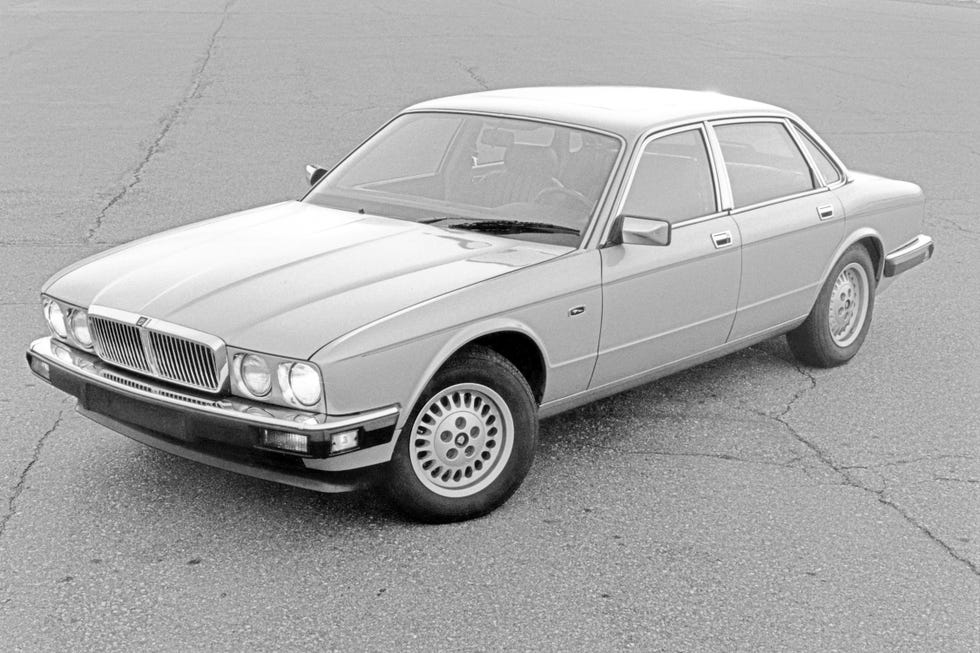
As we saw it previewed in our January issue, the XJ6 remains a pretty zingy sedan. In the sheetmetal, it come across more stolid, not as sleek as we had hoped. Despite Jaguar's aggressive image, the company remains conservative overall, doubly so after querying current owners of old XJ6s about styling. These known feline fanciers cried out for the new line to follow the old form (and thus provide better trade-in value for their graying toms). The result is an aerodynamically cleaner machine, but one that is boxier and has less charm. The new car is also said to be less expensive to build.
The $40,000 American model shares its high-line trim with its European brother, known as the Sovereign. We get power everything and enough on-board electronics to fry a Russian sub under the polar icecap without ever leaving West Palm Beach. The XJ6 lacks the Sovereign's dual rectangular aero headlights, however, arriving with round quad lights similar to those of Europe's low-line XJ6.

The XJ's new shape offers a worthwhile aerodynamic improvement, with a drag coefficient of 0.37, but still breaks wind twenty percent worse than the most modern luxury touring sedans. Although its flattened nose is clearly smoother than the old favorite's, today's XJ runs nose high and tail low, like Dick Butkus caught out in a stiff breeze in a tux. Sad to say, a stiff breeze displaces the XJ, wagging it through an invisible slalom.
A bumpy road carries out the same disservice for the all-independent suspension. In front the new car is similar to the old, with unequal-length control arms, coil springs, and an anti-roll bar. In the rear a new design does away with the complexity of the previous setup, which consisted of a lateral link, a trailing link, a fixed-length half-shaft, and two coil-over-shock assemblies on each side—and which provided reassuring stability when running on bad roads. Lumpy pavement has the advantage of the new rear arrangement, which comprises imaginatively mounted control arms, fixed-length half-shafts, single coil springs, and hydraulic load leveling. The car sometimes mistracks, not being imbued with the calm sense of purpose of, say, a big Audi. Despite its recent corporate growth, Jaguar can marshal engineering resources that represent only a fraction of those available at larger manufacturers.

Considering this handicap, the Jaguar offers a magnificent ride—better by far than any German blitzer can do, and right up there with the cushiest to tool out of Motown. Jaguar's steering and handling fall somewhere between, leaning toward Michigan meander. The steering is still light, though heavier than it used to be, and it feels once removed, as if the car means to keep secrets about the outside world. Skidpad testing coerces the XJ's 205/70VR-15 Pirelli P5s into modest 0.75-g cornering. On the road, the soft suspension may be good for the ride, but it can't keep the big cat from occasionally bounding around in ways none too playful. Every king-size bump delivers a sizable oscillation of nose float and bump steer. If an equally big dip follows, the belly may bottom.
For the most part, Jag's new Bosch-equipped ABS brake system, which boasts yaw-control technology, works without bother. It tugs the XJ down from 70 mph to decidedly unpanicky stops in only 180 feet. The four-wheel discs, vented in front, show no fade. Brisk driving, however, reveals lumpy transitions when you feather the brakes while blending the slightly notchy steering into the bends.
Inside, the leather-wrapped wheel rides high, and no tilt feature accompanies its telescopic talents. Despite the XJ's size, headroom comes up short—the price paid for a low roofline. The headliner around the sunroof keeps drivers of even modest stature from sitting high enough to come to level grips with the wheel. Chin-ups feel like the order of the day.

Thanks to Jaguar's newfound fascination with electronics, giving orders of the day to the many soft-touch controls or taking them from the mishmash of instruments proves a trial-and-error tribulation. A stack of horizontal electronic bar-graph gauges mixes miserably with the old-fashioned but clearly legible round mechanical speedometer and tachometer. This setup rates a raucous raspberry. When our fuel tank was full, the gas gauge lit up only to the three-quarters mark. Our cruise-control "set" button sometimes didn't. The turn-signal lever always requires a reverse tap to stop the blinkers after a lane change. None of this bodes well. Great Britain's legendary Joseph Lucas, the short-circuit pioneer who never managed to make lighting strike twice in the same place, was known for good reason as the Prince of Darkness. Ever hoping for a brighter flash of inspiration, loyal Jaguar still does business with the old boy's disciples, but considering the XJ's wholesale infusion of electronic gewgaws, even His Darkness must be sufficiently shocked to turn over in his grave.
Luckily, the XJ's leather seats, though flattish, are not a letdown for those interested in discharging only their driving duties. The lumbar-adjustment knobs work fine, and any shortage in bolstering is offset by the confines of the cockpit: rakish console and door panels cling close, as if intended for bracing your legs, a generous dead pedal props up your left foot, and the various supports meld into suitably wedged triangulations with your hips and the seat. Oh, your right knee hides the seat buttons, tucked way down on the side of the console, but at least their recessed mounting keeps you from jolting your backside into a midcorner revelation.

Although your own body's bracing is first-rate, the Jag's structure does not provide the solidity of a Benz or a BMW. Still the XJ's envelope feels pretty good.
The XJ's rear seat enjoys the same luxurious wood, leather, and cut-pile trimmings lavished on the cockpit and offers reasonable room for heads, elbows, and feet to boot. And the carpeted "boot," as Jag-yoo-er would say, is more than reasonably roomy.
At low revs, Jaguar's 3.6-liter six hasn't enough muscle to keep up with the expensive-sedan crowd from a stoplight. Despite double overhead cams and a 24-valve head juiced by Lucas fuel injection, the 8.2:1 pistons can't pump up enough pressure to pop a tart. Kitted out to sip America's regular unleaded like afternoon tea, the Jag turns in 17 mpg on the EPA city cycle and 15 mpg under C/D's feet.
Nearly swamped by its rock-bottom compression ratio, the inline-six gives up 37 hp in emissions-controlled trim, steaming to the States with only 181 hp on the boil. A torque curve that tops out at a peaky 3750 rpm and a tall final-drive ratio make for a weak strain of tea indeed to serve in a 3900-pound cup. When the revs are low, this cat won't go. Getting from 0 to 60 stretches into a catnap of nearly eleven seconds. Despite a nearly identical ratio of curb weight to engine size, the Mercedes 300E automatic outruns the XJ6 by 2.5 seconds to 60 mph and by 1.9 seconds in the quarter-mile. Get the Jag over 3500 rpm, however, and the lubriciously delightful ZF four-speed automatic picks gears with effortless alacrity. Suddenly it's kitty bar the door. The lockup torque converter whirs you straight to 128 mph. But get caught at the line and this fat cat is dogmeat.
Jaguar had a tough time honing the inherent shakes out of the willowy steel crank twirling around in its flexy aluminum block. For the moment, the crank and the pistons are only cast, not forged, and the crank isn't fitted with full counterweights. In other words, the XJ6 has not yet been built up to the full fighting ferocity needed to face down the growing gantlet of tough luxury sedans. Still, knowing that Jaguar can be quick to claw back, we are about to see how much fight this cat has in it. Conversely, depending upon Jaguar's final resolve, we may one day see how much cat this fight has in it.
Technical Highlights
From Coventry with fervour.
Fashions in rear suspension keep changing. Not long ago, anything independent was considered stylish. Then Porsche introduced the Weissach axle on the 928, and deflection steer became the bright idea. Now several manufacturers are enamored of four-wheel steering.
While others swing with the fashions, Jim Randle, Jaguar's director of engineering, continues to put his faith in an old-time religion: keep the rear wheels pointed straight ahead, no matter what else is going on. Mainstream car companies would be embarrassed by an idea so basic.
Randle came to the new XJ6 with a short list of rear-suspension wants. He wanted plenty of fore-and-aft compliance, because allowing the wheels to move rearward when they strike bumps is one of the keys to ride comfort. He wanted minimum squat, because pitch upsets ride comfort and disrupts handling. Of course, both of these wants had to be satisfied without steering the wheels.

The solution is a new suspension that amounts to a brain teaser of links and brackets, all cushioned by rubber bushings. It's an arrangement so inscrutable that we asked for a guided tour.
Randle reveals the most important details. Following Jaguar practice, fixed-length half-shafts serve as upper control arms, but the rest of the design is untraditional. Lower control arms locate the wheels both laterally and longitudinally, without the aid of trailing links, and they are mounted to the differential housing by means of a mysterious lash-up that Randle calls a "pendulum ring." This device allows easy rearward movement of the arms but very little lateral movement.
All of these suspension and driveline pieces are mounted on a subframe that is bolted to the underbody with rubber isolators. These mounts are specially positioned to prevent the subframe from steering relative to the car.
Also contrary to Jaguar tradition, the disc brakes have been moved outboard. Their extra unsprung weight adjust the wheel-hop frequency to a more favorable range.
On the road, you're oblivious to all these pieces. But they result in a car that is more nimble than its 3929 pounds suggests. Randle's religion may not be very fashionable, but it does have its virtues. —Patrick Bedard
Counterpoints
The clock ticks slowly indeed in Jaguarland. A decade passes before anyone notices that the flagship of the fleet could use an updating. The new-model developmental process lasts another seven years.
This laxity could be dismissed as mere eccentricity if the new XJ6 were as remarkable as the original, but it's not. The new Jag should be called the XJ6S, the "S" standing for "slightly": slightly less overweight, slightly changed in appearance, slightly more efficient.
The new XJ6 is also a slightly better car overall, but by no means in every category. The engine in our test car missed a beat every now and then at idle. Its low-end torque was disappointing. The steering column shook over bumps. And it suffered from built-in design flaws: a stalk-mounted horn button, a silly J-gate shifter, and an awkward mix of electronic and conventional instruments.
On the plus side, the new anti-lock brakes work well, the acceleration above 35 mph is respectable, and the styling—both inside and out—is charming. The XJ6 is also simpler to build than its predecessor. But don't expect this last breakthrough to be reflected in its price tag. —Don Sherman
The new XJ6 has been treated to some pretty heady press notices across the pond. Read an English road test and you'll find that the revamped Jag can trounce a big Mercedes sedan and the new BMW 735i with equal ease. Indeed, more than one British publication has proclaimed the XJ6 the finest sedan in the world.
Looks to me as though English pride has run a little amok. A supercreamy ride and an elegant interior do not a worldbeater make. The best sedan in the world should move like a leather-lined race car; but compared with the potent German thoroughbreds, this new Jag is a dog. The XJ6 also lacks the feel of sophistication and precision inherent in all Bimmers and Mercs.
The new Jaguar fails aesthetically as well. The old XJ6 was perhaps the best-looking sedan in the world, but the new one is nondescript and bland. A car ought to deliver a lot more than this Jag does before it's even considered in the running for "world's best." —Arthur St. Antoine
Time is the ultimate test of all things, and the old XJ6 had the last laugh before it exited life's stage. A celebrated ingénue that became an all-but-forgotten spinster, it triumphed in the end by proving to be an ageless beauty—a classic motorcar that just about wrote the book on silky elegance.
The new XJ6 has a tough act to follow. Like all postwar Jag sedans, it owes a lot to its predecessors—maybe too much. I get the feeling that the designers and the marketing men were fearful of moving too far afield from the magic formula that had served them so well for nearly two decades.
From its derivative, dowdy styling to its underachiever engine and overweight body, the XJ6 underwhelms me. It fails to match the old warrior's celestial ride quality or the flowing grace of its sheetmetal. And in a world full of German road rockets, the new Jag's performance is uninspiring. Where are the advances to carry it through the next twenty years?
We've waited a good long time for Jaguar to write the next chapter in luxury cars, but I'm afraid the story pays too much homage to the past and not enough to the future. —Rich Ceppos

Specifications
Specifications
1987 Jaguar XJ6
Vehicle Type: front-engine, rear-wheel-drive, 5-passenger, 4-door sedan
PRICE
As Tested: $40,000 (est)
ENGINE
DOHC 24-valve inline-6, aluminum block and head, port fuel injection
Displacement: 219 in3, 3590 cm3
Power: 181 hp @ 4750 rpm
Torque: 221 lb-ft @ 3750 rpm
TRANSMISSION
4-speed automatic
CHASSIS
Suspension, F/R: control arms/control arms
Brakes, F/R: 11.6-in vented disc/10.9-in disc
Tires: Pirelli P5 Cinturato
205/70VR-15
DIMENSIONS
Wheelbase: 113.0 in
Length: 196.4 in
Width: 70.8 in
Height: 53.5 in
Passenger Volume, F/R: 51/40 ft3
Trunk Volume: 13 ft3
Curb Weight: 3929 lb
C/D TEST RESULTS
60 mph: 10.8 sec
1/4-Mile: 18.2 sec @ 81 mph
100 mph: 29.8 sec
Top Gear, 30–50 mph: 4.5 sec
Top Gear, 50–70 mph: 7.3 sec
Top Speed: 128 mph
Braking, 70–0 mph: 180 ft
Roadholding, 300-ft Skidpad: 0.75 g
C/D FUEL ECONOMY
Observed: 15 mpg
EPA FUEL ECONOMY
City/Highway: 17/24 mpg


