
From the May 1994 issue of Car and Driver.
Have you wondered: What sports car would the road testers keep poised behind their own garage doors, on 10-second alert, gassed and gleaming, ready to light the burner and blur the pavement on those occasional sorties of the utmost therapeutic importance?
Hey, road testers have fantasy lives, too.
And if the automatic teller were ever to go Robin Hood on us, the great sucking sound you'd hear would be a heartwarming number of Acura NSXs being drawn toward Editorial Headquarters. The testers of this magazine are of one mind about the NSX, so much so that we can finish each other's sentences.
"The low, forward, cockpit is exhilarating . . . like riding in the head of an arrow."
"It's so precise in its responses . . . as if it were hard-wired into my cerebellum."
"It's exotic and rare . . . but it doesn't have to prove it by beating me up."
"A breakthrough sports car . . . now in its fourth year and still at the cutting edge."
For Sale Near You
See all results for used 1994 Acura NSX for sale near 60323

We C/D testers are unanimous: the NSX is our top choice for pure driving pleasure. Yet despite our enjoyment of its moves and our admiration for the all-aluminum construction that puts it on the good side of the F=ma equation, the NSX remains widely misunderstood, neither coveted nor respected in fair proportion to the joy it delivers.
Why is that?
For one thing, there's no other high-performance car on the planet that's so poorly described by its test-track numbers. It's fast—zero to 60 in 5.2 seconds, quarter-mile in 13.7 seconds at 104 mph, top end of 162 mph. It stops—170 feet from 70 mph, with very good control from its four-channel anti-lock brakes. It turns—0.93 g, with a mild understeering balance.
Fast, but not a record setter. Several other exotics have more power and put more rubber on the road. But remember that these are test-track numbers, limits-of-the-envelope readings obtained with the driver at full alert and plenty of runoff room to catch the histrionics.
Track numbers say nothing about usable performance. Exotics are notoriously tricky to drive, and street-usable performance is typically well below the track numbers. Except for the NSX. This machine is so honest and predictable in its responses that most of its track performance is also useful performance. Out in the world, the NSX's no-sweat capabilities top the charts.
Also against the NSX is the perception that it lacks intensity. There's a half-truth here. "For a quick blast, the Ferrari F40 is more fun. But in a half hour I'm done with it," says one of our crew. The NSX, on the other hand, is a splendid partner for a quickie and we're never done with it. We would drive it every day. We'd happily commute in it. In the quest for perfection, Honda is used to playing in a tougher league. It holds itself to higher standards. One example: Despite the NSX's speed, it's not a gas guzzler, not even close. On one recent 713-mile trip, we logged 25.5 mpg. Another example: to reduce transmission noise, the 1994 NSX has re-contoured gear teeth.
Uh, what noise? We never heard it.
How much intensity can you stand? Recall that a little bit of Clyde Barrow was all most folks could stand. The usual exotic-car intensity comes from noise—shrieks and whines that are briefly amusing but quickly fray the nerves—or recidivist behavior that requires the driver's full attention just to complete ordinary moves. You may have noticed that every test of the red Italian in the last 30 years complains about the shifter. And if it didn't, it should have. True, such idiosyncrasies make vivid cars, but vivid is not the same as precise and attuned. It's not as satisfying either.

The NSX is the most precise and attuned mid-engined machine we've ever driven. No big deal. Just the everyday story of the Honda Motor Company playing in the tough league. Remember, Honda satisfies millions of customers every year who expect the seats to fit them, no matter their shape, expect to see the instruments without dodging their gaze around the wheel rim, expect the lever to snick into the next gear while they pay zero attention to the process.
Imagine a mid-engined sportster with every ergonomic detail as correct as in an Accord. It's simply never been done before. The NSX starts from that level. Then it excels. The seats have only two adjustments, fore-and-aft and seat-back angle. But they fit our long guys and our short guys, our wide guys and our lean guys, and they augment their lateral support with padding at the shoulders. So the side forces are broadly distributed.
The brakes are so unsquishy you'd think you stepped on a rock instead of a pedal. The clutch is Honda easy, thanks to its twin-disc design.
Like all wide-tired cars without power steering, turning effort is high. Until the tires begin to roll. Then the workout fades to amazing precision. You get feedback without kickback. Most staffers mention the steering in their first paragraph of NSX superlatives.
They exclaim over the view out the windshield too. Honda designers worked to a very specific motif when they drew up this car—the F-16 fighter jet. They imagined the panorama that opens to the pilot, out through the bubble canopy and over the drooping nose. They tried for that same sensation in the NSX. Oh, yes; oh, yes. An F-16 for the road.

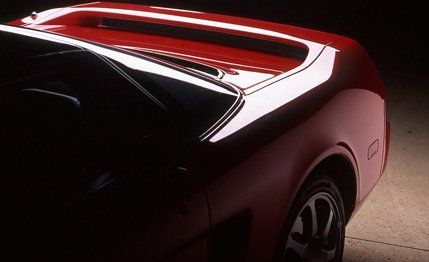
The black roof is part of the theme. All NSXs, except for some of the dark green ones starting this model year, have black roofs. Most mid-engined coupes have the roof integrated into the basic architecture: they look like coupes. But F-16s show you a fuselage trailing into an empennage. The canopy is transparent and not obvious at first glance. The NSX has a short roof far forward, with narrow, sloping pillars. And it's painted black. It hides from your eyes. The canopy look. Inside, you get the canopy feeling too, with an unmatched view in all directions. It's uplifting, exhilarating, liberating.
Liberating. Uh, not a term we'd use for other exotics, yet it applies perfectly to the NSX. Most exotics are blind toward the rear quarters, a source of unease in traffic. And most force the driver into an uneasy position, with awkward reaches and disadvantageous leverages on the controls. Not so the NSX. It simply fits, snugly, intimately, appropriately, from the hips on down, yet it seems to widen above the tunnel, above the armrests, to give plenty of elbowroom, a sense of spaciousness, room to work.
And it gives you the tools to work, to perform surgery on the road. The steering cuts so accurately. The torque comes in so broadly, accompanied by the sound of precision sewing machinery, turning to a growl in the midrange, revealing itself to be a grizzly as the VTEC switches to the high-speed cam profiles at full-throttle 5800 rpm. Talk about liberation. Allowed is 8000; enjoyed is 8000. Those titanium connecting rods aren't back there for the weight distribution.
Still, power is not the centerpiece of this car. We're back to liberation again. This car is about motion, about translating driver talent directly into g-forces. You guide the steering. You caress the pedals. You do the right things. And it does the right things. Yes, you can throw it around and end up throwing it away. But it's more tolerant of uneducated inputs—of abrupt lifts off the power or stab of the brakes—than any other exotic we've met.
How, exactly, does it handle? Great. Braking into turns very late, and very deep, is a move for the postgraduate. It puts the nose down, loads the outside front, and makes the tail light. Do it wrong and you'll spin bigger than the Supercollider. The NSX will go deeper than we will.
Early NSXs earned a reputation for rapid tire wear, particularly at the rear. Honda specified lots of rear-wheel toe-in to keep the tail from stepping out, 6mm total. That was reduced to 4mm starting with the 1993 models. Stability is still fine, we think. But tire wear is probably a trade-off in the design of this car. The Treadwear Grade number on the sidewall is 120, the lowest we've seen on an original-equipment tire, and suggests a tire life two-thirds that of a Corvette tire labeled 180.
The only significant visual change for 1994 is wheels one inch taller and a half-inch wider at all corners—7.0 by 16 inches in front, 8.5 by 17 in back, with 215/45 and 245/40 Z-rated tires. Red, black, and white exterior colors are continued, a new dark green replaces silver.
Price is up, to $77 ,265 for the base car, including destination charge and luxury tax. An awkward place—too expensive for most buyers, too cheap to be regarded as truly precious. On the usual exotic-car scale that equates preciousness with rarity, the NSX is a terrible misfit. Honda built a special factory for this car. It wants to push out 25 a day to recoup its investment. What the NSX offers, instead of rarity, is the detail refinement in both engineering and manufacturing that only a large, top-line carmaker can bring. Consider: In the Initial Quality Survey from J.D. Power & Associates, the NSX was found to have 71 defects per 100 cars in 1991 ,57 in 1992 (although the sample size was too small this year to be statistically certain). For the same years, Lexus scored 55 and 73, Mercedes scored 91 and 127. Industry average in 1992 was 125. Clearly the NSX is well built in a way that expensive sports cars usually aren't.
The NSX will never be rare. But it works beautifully, which is more precious to us.

Running Wide Open
Honda's supercar goes convertible.
In one respect, Acura 's NSX is exactly like any other exotic sports car: someone, somewhere will want to heighten its appeal by lopping off its top. Doron Izakov made the rounds of conversion shops, looking for one willing to cut into the NSX's unique aluminum structure. Newport Car Conversions in Norwalk, California, agreed to use his car as a prototype to develop an NSX convertible.
The result is an intriguing open-air car with handsome, well-integrated lines, an easy-to-operate top, and decent chassis rigidity. Newport can duplicate Izakov's car for about $15,000.
This conversion is something of a targa/soft-top hybrid. A hard, canvas-covered-fiberglass roof panel unbolts—using the Corvette's cute little ratchet wrench and four screws—and stows in the trunk. The car can be driven that way. In fact, for those who prefer the targa configuration, Newport offers that conversion as well. (And Honda will release its own targa option late this year.)

But a pop-top doesn't give the same open-air driving experience as a full convertible. To get that from the Newport conversion, just pull off the rear canvas panel. It has snaps around the lower edge and hook-and-loop strips across the top on an overhead bar. This bar (to which the targa panel's rear edge bolts, when everything is buttoned up) then unlocks and folds down. It hides under the hinged, black-fiberglass boot lid that nicely fills the hole left by the sloping back glass of the original roof.
Extensive bracing, using welded-in aluminum tubing, replaces much of the structural integrity lost along with the original roof. So cowl flutter on bumps and rough pavement is minimal. And there is even fairly good control of drafts and buffeting in the open cockpit. It is, in the end, a brilliant car made breezy. —Kevin Smith

NSX-cellent Project
They build one for us.
For a year or so, we've been hooked on the idea of, well, an enhanced NSX. Then we discovered Honda was already building one. Sort of. The resident NSX-pert in the headquarters' service shop, a fellow who knows the car intimately, was tinkering with an old NSX mule on his own time. And Comptech, the savvy northern California race shop that ran the company's successful IMSA Camel Lights program, had some NSX tuning parts on offer and the know-how to develop more. When they heard we were thinking along the same lines, the project suddenly came to fruition.
Still, we wondered, what might this enhanced NSX be like if it were built with the factory's own resources, tapping in-house expertise? How would these people improve the car? Would there ever be a better way to create a quicker, sharper, more forceful NSX, one that was still completely street-civilized? (Because this one was our idea, we waived our usual requirement that engine modifications already have EPA emissions approval.)
Comptech's Don Erb supervised the creation of what is surely one of the sweetest road cars we've ever driven. The stopwatch confirms the modified 1993 model is quicker than this month's 1994 test NSX: it runs 0 to 60 in 5.0 seconds (versus 5.2 for the stocker), the quarter-mile in 13.4 seconds at 109 mph (13.7 at 104), and to a top speed of 175 mph (162). There's also a lovely exhaust howl following you about, which suggests the first step Comptech took to perk up the 3.0-liter V-6. New exhaust plumbing uses beautifully fabricated tube headers and a low-restriction muffler (plus the original cat-con). The system boosts output from the stock 270 hp to a claimed 315, and it's available from Comptech for a princely $2870. These parts will be 50-state EPA-approved shortly.
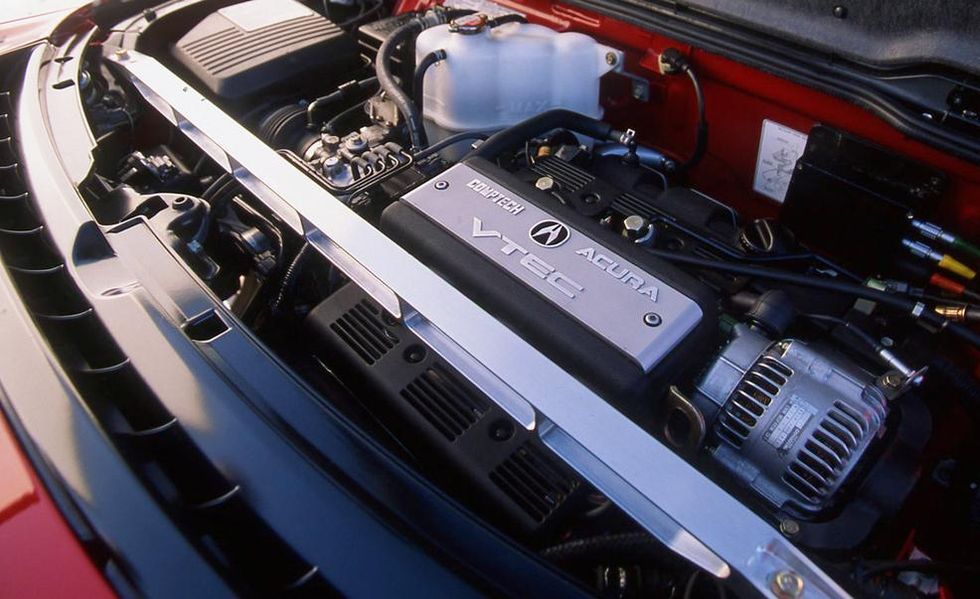
But that wasn't the end of it. Comptech pulled the cylinder heads, milled the mating surfaces for a bit more compression, and opened up the ports slightly. The intake manifold and air box were also reworked for better airflow, and the fuel-injection chip was reprogrammed. New camshafts were installed, and here the NSX's VTEC variable-timing-and-lift technology provided a sneaky opportunity. The high-speed cam lobes were ground for greater lift and duration, but the low-speed lobes retain their mild, stock profile. And guess what? The engine only runs on the low-speed lobes in the EPA test. This configuration has not been submitted for emissions testing, but Don Erb is confident it would pass.
The dyno sheet shows a peak of 358 hp at 8000 rpm. Increases below 5000 rpm are modest, but the transition to the VTEC's deep-breathing mode, at 5800 rpm, is much more pronounced than in a standard NSX. And from there up to 8500 rpm, revs build in a rush.
Crisp, immediate response, especially in the steering, is an NSX forte, and eliminating some of the suspension's rubber bushings has made it even more of one in the C/D-Honda-Comptech car. Road feedback is crystal clear, yet ride harshness has increased only fractionally. New springs and adjustable Koni dampers carry the car about an inch lower. Yokohama A-022 tires, a standard NSX fitment for 1994, are mounted on Volk Racing modular wheels 7.5 inches wide in front (a half-inch wider than stock), 8.5 in back.
Anti-roll bars are unchanged, but fine-tuning of camber and toe adjustments has resulted in an even more enthusiastic handling balance than the stock NSX has. Protective understeer has been dialed back, making the car more neutral overall and quicker to oversteer under power. It remains easily controlled, however, as well as communicative and friendly. At a given level of driver commitment and intensity, this is the quickest car we've ever taken over some of the canyon roads we use for testing.
An endearing quality of Acura's sports car is that it's so pleasing to operate—even just running errands—that all-out speed doesn't matter much. The C/D-Honda-Comptech NSX just has a lot more speed to be unconcerned about. —Kevin Smith

Specifications
Specifications
1994 Acura NSX
Vehicle Type: mid-engine, rear-wheel-drive, 2-passenger, 2-door coupe
PRICE
As Tested: $77,355
ENGINE
DOHC 24-valve V-6, aluminum block and heads, port fuel injection
Displacement: 182 in3, 2977 cm3
Power: 270 hp @ 7100 rpm
Torque: 210 lb-ft @ 5300 rpm
TRANSMISSION
5-speed
DIMENSIONS
Wheelbase: 99.6 in
Length: 174.2 in
Width: 71.3 in
Height: 46.1 in
Curb weight: 3030 lb
C/D TEST RESULTS
60 mph: 5.2 sec
100 mph: 12.7 sec
130 mph: 23.2 sec
Rolling start, 5–60 mph: 5.6 sec
Top gear, 30–50 mph: 7.1 sec
Top gear, 50–70 mph: 7.2 sec
¼-mile: 13.7 sec @ 104 mph
Top speed (drag limited): 162 mph
Braking, 70–0 mph: 170 ft
Roadholding, 300-ft-dia skidpad: 0.93 g
C/D FUEL ECONOMY
Observed: 25 mpg
EPA FUEL ECONOMY
City/highway: 19/24 mpg


