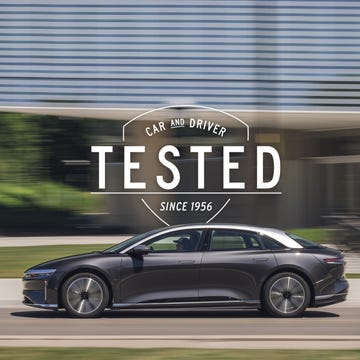
- For 2024, the single-motor Polestar 2 has made the switch from front- to rear-wheel drive, an unheard of year-over-year change.
- From a more equal weight balance to much more playful limit handling, the Polestar 2 is better for it. Even efficiency doesn't suffer.
- We may start to see more rear-drive EVs in the mainstream realm, such as the recently launched Chevy Blazer EV.
Welcome to Car and Driver's Testing Hub, where we zoom in on the test numbers. We've been pushing vehicles to their limits since 1956 to provide objective data to bolster our subjective impressions (you can see how we test here).
Sure, there's the odd example of a nameplate that switched which axle is powered over the course of its lifetime—such as the Chevy Malibu or Toyota Corolla—but it's unheard of that a change from front- to rear-wheel drive would take place without the major architectural tear-up of an all-new generation. However, with EVs, the surgery becomes much less invasive; the 2024 Polestar 2 flipped from front-drive to rear-drive for the entry-level, single-motor variant, and it's much better for it. The comparison between 2023 and 2024 models isn't 100-percent perfect, because the latest model did have a few other changes, but let's dive in.
For Sale Near You
See all results for used 2024 Polestar Polestar 2 for sale near 9711 aa

Looking at the Data
The curb weight of a 2022 model we tested was 4460 pounds, with 54.7 percent on the front axle. The 2024 model also gets a slightly larger battery pack (79.0 kWh versus 75.0), so the weight of the latest car we tested was up slightly to 4516 pounds, but the front/rear split is much more balanced and shifts to a slight rear bias, with 48.8 percent on the front axle and 51.1 on the rear.
The benefit? The front-driver was a boring, moderate understeerer at the limit around our skidpad while the new car's tail is as playful as a contented kitten's, stepping out but easily controllable using the accelerator. Chalk up a big win for rear-drive.

Although the tires aren't identical between the old and new 2s, they're about as close as can be, with the old car on 19-inch Michelin Primacy 4s and the new one on Michelin Primacy All Seasons in the identical size. Both ended up with the same 0.88-g skidpad result, and the braking was all but the same (70 mph–0 in 166 feet for the rear-driver, 161 for the front-driver). Our interior-noise measurement was identical between the two cars as well, at 69 decibels at 70 mph.
Thanks to its new battery pack, the latest 2 also gets a substantial power increase and blows the doors off the 2022 model, shrinking its sprint to 60 mph by 1.3 seconds, the quarter-mile by 1.1, quickening its midrange passing times, and raising top speed to 130 mph from 101. But the at-the-limit balance isn't power induced, it's pure weight balance and chassis.
Further to that point, the Volvo XC40 Recharge shares its powertrain with the Polestar 2, and its single-motor version also switches to rear drive for 2024, but it does so without the injection of fun at the limit.
Making the Switch
Switching from front- to rear-drive in a gas-powered car would likely mean running a drive shaft to the rear axle, which would reduce efficiency and hurt packaging too. But there's neither downside following the Polestar 2's motor relocation rearward.

Its EPA range climbs from 270 to 320 miles, although much of that gain is due to the additional battery capacity. But its EPA combined efficiency also climbs by 7 percent, from 107 MPGe to 115. In our 75-mph highway test, the 2024 model went 250 miles, 30 farther than before, which means on a per-kilowatt-hour basis, the rear-drive model shows a nearly 10 percent improvement, from 2.9 miles per kWh to 3.2. And the cargo volume behind the rear seats or in the frunk doesn't budge either.
Better dynamics and performance without any downsides, including efficiency? (Yes, we've considered snow traction, and we stand by our no-downsides comment. Buy winter tires, naysayers.) Perhaps the Polestar 2's all-upside switch can convince other automakers to make the move to rear-wheel drive.

Specifications
Specifications
2024 Polestar 2 Plus
Vehicle Type: rear-motor, rear-wheel-drive, 5-passenger, 4-door hatchback
PRICE
Base/As Tested: $53,500/$56,750
Options: Pilot package, $2000; Midnight Metallic paint, $1250
POWERTRAIN
Power: 295 hp
Torque: 361 lb-ft
Battery Pack: liquid-cooled lithium-ion, 79.0 kWh
Onboard Charger: 11.0 kW
Peak DC Fast-Charge Rate: 205 kW
Transmission: direct-drive
CHASSIS
Suspension, F/R: struts/multilink
Brakes, F/R: 13.6-in vented disc/12.6-in vented disc
Tires: Michelin Primacy All Season
245/45R-19 102V M+S POL
DIMENSIONS
Wheelbase: 107.0 in
Length: 181.3 in
Width: 73.2 in
Height: 58.2 in
Passenger Volume, F/R: 55/38 ft3
Cargo Volume, Behind F/R: 39/16 ft3
Curb Weight: 4516 lb
C/D TEST RESULTS
60 mph: 5.5 sec
1/4-Mile: 14.2 sec @ 97 mph
100 mph: 15.2 sec
130 mph: 34.8 sec
Results above omit 1-ft rollout of 0.3 sec.
Rolling Start, 5–60 mph: 5.6 sec
Top Gear, 30–50 mph: 2.1 sec
Top Gear, 50–70 mph: 3.2 sec
Top Speed (gov ltd): 130 mph
Braking, 70–0 mph: 166 ft
Roadholding, 300-ft Skidpad: 0.88 g
C/D FUEL ECONOMY
Observed: 89 MPGe
75-mph Highway Range: 250 mi
EPA FUEL ECONOMY
Combined/City/Highway: 115/124/106 MPGe
Range: 320 mi
2022 Polestar 2 Single Motor
Vehicle Type: front-motor, front-wheel-drive, 5-passenger, 4-door hatchback
PRICE
Base/As Tested: $47,200/$52,400
Options: Plus package (sunroof with projected Polestar symbol, heat pump, heated rear seats, Harman/Kardon premium sound system, heated steering wheel, power seats, wireless phone charging), $4000; Thunder grey paint, $1200
POWERTRAIN
Motor: permanent-magnet synchronous AC, 228 hp, 243 lb-ft
Battery Pack: liquid-cooled lithium-ion, 75.0 kWh
Onboard Charger: 11.0 kW
Transmission: direct-drive
CHASSIS
Suspension, F/R: struts/multilink
Brakes, F/R: 13.6-in vented disc/13.4-in vented disc
Tires: Michelin Primacy 4
245/45R-19 102V POL
DIMENSIONS
Wheelbase: 107.7 in
Length: 181.3 in
Width: 73.2 in
Height: 58.2 in
Passenger Volume: 91 ft3
Cargo Volume: 16 ft3
Curb Weight: 4460 lb
C/D TEST RESULTS
60 mph: 6.8 sec
1/4-Mile: 15.3 sec @ 93 mph
100 mph: 18.6 sec
Results above omit 1-ft rollout of 0.3 sec.
Rolling Start, 5–60 mph: 6.9 sec
Top Gear, 30–50 mph: 2.5 sec
Top Gear, 50–70 mph: 3.8 sec
Top Speed (gov ltd): 101 mph
Braking, 70–0 mph: 161 ft
Roadholding, 300-ft Skidpad: 0.88 g
C/D FUEL ECONOMY
Observed: 75 MPGe
75-mph Highway Driving: 89 MPGe
75-mph Highway Range: 220 mi
EPA FUEL ECONOMY
Combined/City/Highway: 107/113/100 MPGe
Range: 270 mi
Dave VanderWerp has spent more than 20 years in the automotive industry, in varied roles from engineering to product consulting, and now leading Car and Driver's vehicle-testing efforts. Dave got his very lucky start at C/D by happening to submit an unsolicited resume at just the right time to land a part-time road warrior job when he was a student at the University of Michigan, where he immediately became enthralled with the world of automotive journalism.