Welcome to Car and Driver’s Testing Hub, where we zoom in on the test numbers. We’ve been pushing vehicles to their limits since 1956 to provide objective data to bolster our subjective impressions (you can see how we test here). A more comprehensive review of the 2022 Rivian R1T can be found here.
In many ways, Rivian makes it very easy to use the R1T as a tow rig. When you connect trailer wiring to the R1T, a Towing option that isn't normally there appears on the mode-selection screen, and the buttons on the right side of the steering wheel morph to take command of the integrated trailer-brake controller, which, if you are hauling anything close to its 11,000-pound rating, you will want to dial in.
But before you go plunking down a deposit on your new R1T to tow your boat, consider how and where you want to tow your boat.
Switching to Tow mode comes with some ominous foreshadowing, as the R1T's indicated range disappears, instantly going from 270 miles to 103. So, for all intents and purposes, cross-country trailering with the R1T is like trying to go on a road trip in a Mazda MX-30, a car with 70 miles of range at 75 mph. Yes, there are enough DC fast chargers between Ann Arbor and Traverse City, Michigan, to make that trip—a very common weekend getaway for southeastern Michigan residents—possible, but it isn't all that practical.
For Sale Near You
See all results for used 2022 Rivian R1T for sale near 60323

At 75 mph, we found the R1T (unladen, with just a driver) to have a highway range of 220 miles. But with 5650 pounds of BMW E91 328i wagon strapped to a Futura trailer, the real-world range is cut in half at similar speeds. Adding even this moderate trailer turns the one-stop, roughly 4.2-hour trip (including the time to charge) into a four-stop, 6.2-hour affair (according to estimates provided by A Better Route Planner). And that is pulling into Traverse City with just 10 percent charge. Cross your fingers for a tailwind, or only plan to tow on downhill grades.
Fortunately, describing how the Rivian pulls a trailer can be summed up with one word: fabulous. It never feels sluggish off the line or when passing thanks to the four motors and their prodigious torque. When slowing down, the regenerative braking feels natural. Plus, we didn't detect a hint of trailer sway, which is greatly a function of how the trailer is loaded, but we didn't even feel so much as a tug from crosswind.
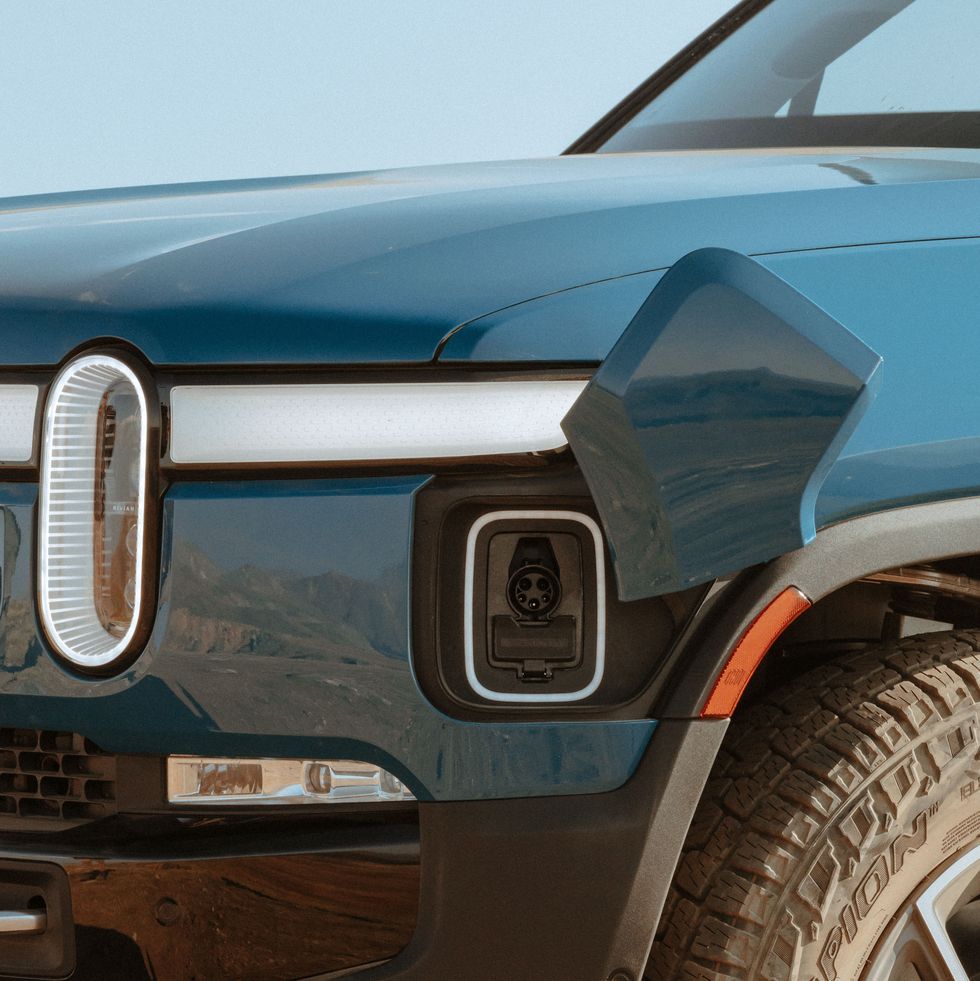
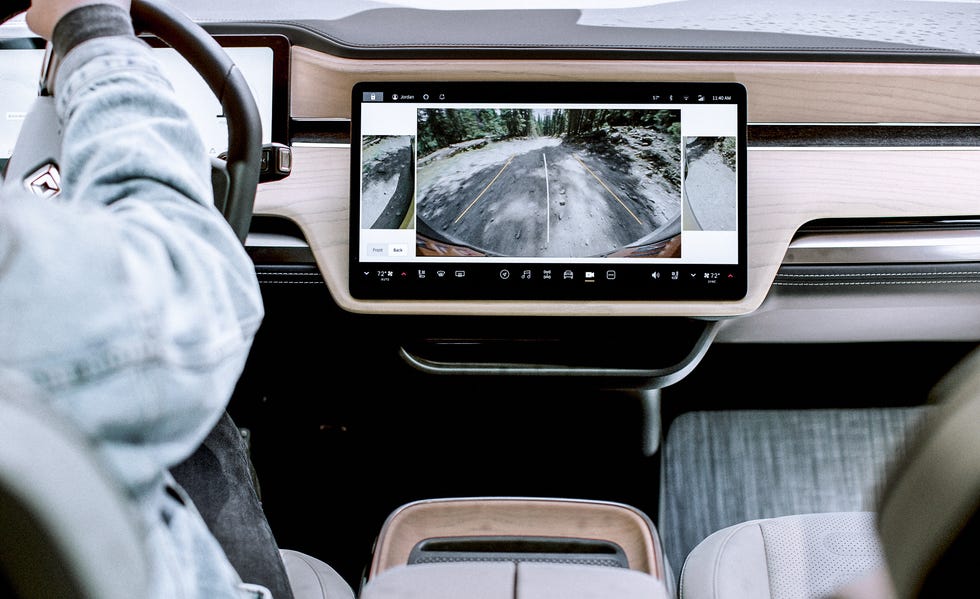
But even if the process of towing is fantastic, the spider-web network of DC fast chargers created by Tesla, Charge Point, Electrify America, and others, wasn't designed with electric pickups towing a trailer in mind. Charging bays are not designed like every gas station, where you can pull through (we know of one pull-through DC fast charger in Baker, California). More likely than not, if you plan to tow a great distance with your Rivian, you will have to disconnect your trailer at every charging stop. The R1T's charge port is in its nose, so there is a chance that you could connect to a DC fast charger with a trailer connected, but whether there is even room to block a few unused parking spots, or an unpopular parking-lot aisle isn't something you can count on. At least all the EVs that can serve as tow rigs have backup cameras, so the disconnect-reconnect jig would happen quickly.
If we conservatively add 10 minutes per stop to deal with connecting and disconnecting a trailer, the hypothetical Ann Arbor–Traverse City trip turns into seven hours, or just about double what Google Maps says the drive would take in a hydrocarbon-burning pickup.
These practical concerns with EV towing aren't unique to Rivian. All EV pickups and SUVs share this same struggle. If all you ever do is run your boat to the local launch, you will love the R1T as a tow rig. Just don't go retiring your favorite tow rig quite yet if your destination requires a DC charge or two.
K.C. Colwell, the executive editor at Car and Driver, is a seasoned professional with a deep-rooted passion for new cars and technology. His journey into the world of automotive journalism began at an early age when his grandmother gifted him a subscription to Car and Driver for his 10th birthday. This gift sparked a lifelong love for the industry, and he read every issue between then and his first day of employment. He started his Car and Driver career as a technical assistant in the fall of 2004. In 2007, he was promoted to assistant technical editor. In addition to testing, evaluating, and writing about cars, technology, and tires, K.C. also set the production-car lap record at Virginia International Raceway for C/D's annual Lightning Lap track test and was just the sixth person to drive the Hendrick Motorsport Garage 56 Camaro. In 2017, he took over as testing director until 2022, when was promoted to executive editor and has led the brand to be one of the top automotive magazines in the country. When he’s not thinking about cars, he likes playing hockey in the winter and golf in the summer and doing his best to pass his good car sense and love of '90s German sedans to his daughter. He might be the only Car and Driver editor to own a Bobcat: the skidsteer, not the feline. Though, if you have a bobcat guy, reach out. K.C. resides in Chelsea, Michigan, with his family.