
You may have heard, but there are some small trucks in the works. Already, the truck community is abuzz with concerns about tow ratings and underpinnings and how many full-dress Harley-Davidsons fit in the bed atop enough lumber to build a biker bar.
None of those things matter.
Well, they do, but Ezra has that conversation covered. What's crucial to know about a small truck is . . . how will it look sitting frame to the pavement and should you go tribal, flames, or just a nice tasteful combo of purple, orange, green, and silver stripes?
Yes, folks, I'm talking mini-trucks, and that free-wheeling community of customizers that saw the rise of small pickups in the 1970s not as lesser versions of their mid- and full-size brethren, but as affordable and accessible canvases for creative expression of fabrication, paint, and tailgate party skills. Mini-truckers have been happily truckin’ away this whole time, but it’s been at least a decade since there have been any truly compact trucks sold new at dealerships. Could smaller trucks like the Hyundai Santa Cruz and the spiritual successor to the old Ranger, the new Ford Maverick, bring the spotlight back to mini-truck culture?
For Sale Near You
See all results for used 2022 Ford Maverick for sale near 60323

As a former owner of a 1978 Datsun 620, I’m not wholly uninvested in this question, but my truck’s most impressive feature was not a killer stereo, but rather an interior that smelled like goats—although to my knowledge, no goats had ever been in the truck. And if it was riding a bit low, it was more about sagging springs than skillful airbag installation. For this discussion, I needed a true mini-truck expert, so I called Mike Finnegan, co-host of several automotive shows (Roadkill, Faster with Finnegan, Finnegan’s Garage), but more importantly, former associate editor of Mini Truckin’ Magazine.
Our first order of business was to define a mini-truck. What makes a truck mini? Are there rules? Is there a size cutoff? Is it like the carry-on at an airport: to be a mini-truck you must fit in this space?
I made Finnegan pull up the most recent spy photos of the new Maverick and asked for his opinion on its size. At first glance, he wasn't impressed. "That thing's huge in the photo! Or render, whatever that is. I mean, dude, that thing's giant. It looks like it's got 22s on it, a bunch of fender gap. It looks narrower than an F-150, but it looks as long as an F-150. From here it doesn't look like traditional sized mini-truck."
"Hang on there, don't give up hope yet," I told him. It looks large in images, but it will undoubtedly be shorter than the 210.8-inch long Ranger and quite a bit shorter than the F-150, which these days measures 231.7 inches.
"My '94 Toyota would have been 174 inches long," he said. "But honestly, most mini-truckers don't really fit that well in their trucks. I never fit in mine. I just like the way it looks when it's parked. So maybe for Americans a slightly bigger truck would be good."
What about the fact that it doesn't come as a single-cab? Does he think that ruins its chances to look good sectioned and bagged? To my surprise, he said not at all.
"So, in my youth, the perfect mini-truck was a standard cab laid flat on the ground. And then, we got wind of the South American S10s that were crew-cabs. Some people started bringing them over, and then we saw crew-cabs laid flat on the ground, and went, 'That looks amazing.' It just kind of depends now on if you are going as small as possible, or are you going to look sportier, or are you going for a big four-door? Anyhow, looking at this Maverick, is it a mini-truck? Dimensionally, no, but I can make it a mini-truck."
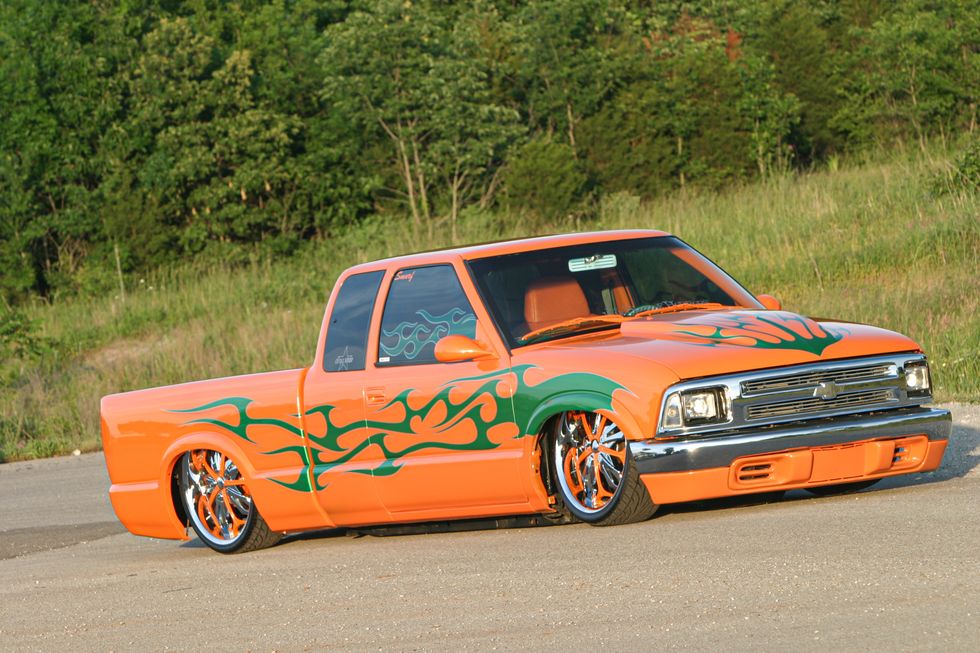
Finnegan went on to tell me that mini-trucking—which came out of '70s van culture and then developed into its own scene—was never very strict about how mini, or even how truckin' something needed to be in order to show up at the meets or lay frame at the cruises.
"We never had to make a formal description of what counted, because it used to be obvious," he said. "Back in the day you had full-sized trucks and you had compact trucks. You had the Ford F-150, 350, and then you had a Ranger. And it was easy to see which one was a mini-truck. We never had to give it much thought. But here's the thing: the physical dimensions of the truck almost don't matter, it's how you build it. If you body-drop something and lay it on the rockers, if you put graphics on it, if you put a bumping system in it, it doesn't matter what the badge on it is, it's a mini-truck to mini-truckers. Which is how mini-truck clubs started letting in compact cars, and even full-size cars.”
A newcomer to a mini-truck show might be startled at the variety, not just in the trucks (and cars) but in how they are presented. There are metallic and gold-leafed paint jobs with hydraulic beds that seem very lowrider-esque and next to that a more hot-roddy flame-job, or a series of interlocking graphics that look like a frat boy’s tattoo.
"Oh yeah, the West Coast tribal graphic paint job, all that stuff came out of central California," Finnegan said. "It might not quite be back in fashion yet, but I bet it will be soon. The thing about mini-truckers, we took a little bit from everybody. We took suspension mods from lowriders, graphics from the guys who were painting surf boards. You can thank mini-truckers for air suspensions on hot rods and muscle cars. A mini trucker was the first person to take big rig airbags and put them on a mini truck in—I want to say, '90 or '91 it happened. And then people laughed at us at least for five or 10 years for doing that. And now they're everywhere.”
So mini-trucking is a philosophy more than a segment, and the key to it all, said Finnegan, was the low price of compact trucks in the '70s, '80s, and ‘90s. "The mini truck thing blew up in the mid-seventies. They were inexpensive, they got good gas mileage. Back then, you had the Toyota pickups, you had Datsuns, you had the Chevy Luv, you had the Mazda Sundowner, you had the Ford Courier, and then the Ranger, even the Colorado—although that was a bigger truck, we still saw them at the shows. My 1994 Toyota, it was $7600, and the rear bumper was an option. Didn't have power steering. It didn't have power windows, no power locks, but I could afford the payment and I immediately took it home and my friends and I started cutting it up, because it was so inexpensive."
Having a cheap truck meant that experimenting with fabrication and paint was a lot more appealing than tearing into an expensive full-size, and Finnegan thinks that the price on the new Maverick will be the deciding factor on if it will excite old-school mini-truckers or not. "If this thing really is a low, or sub-$20,000, the mini-truck community would embrace it," he said. "That leaves a lot of money for mods."
Like a sleeper agent activated late in the game, Elana Scherr didn’t know her calling at a young age. Like many girls, she planned to be a vet-astronaut-artist, and came closest to that last one by attending UCLA art school. She painted images of cars, but did not own one. Elana reluctantly got a driver’s license at age 21 and discovered that she not only loved cars and wanted to drive them, but that other people loved cars and wanted to read about them, which meant somebody had to write about them. Since receiving activation codes, Elana has written for numerous car magazines and websites, covering classics, car culture, technology, motorsports, and new-car reviews. In 2020, she received a Best Feature award from the Motor Press Guild for the C/D story "A Drive through Classic Americana in a Polestar 2." In 2023, her Car and Driver feature story "In Washington, D.C.'s Secret Carpool Cabal, It's a Daily Slug Fest" was awarded 1st place in the 16th Annual National Arts & Entertainment Journalism Awards by the Los Angeles Press Club.


