Our car experts choose every product we feature. We may earn money from the links on this page.
Best Portable Power Stations of 2026
From compact 512-Wh units to massive 2048-Wh ones with optional expansion batteries large enough to power your home, we've rounded up the best portable power stations on the market.

Portable power stations have quietly become essential gear for anyone who spends time away from the grid—whether that's the bed of a pickup at a tailgate, a remote campsite, or your driveway during a blackout. These compact units offer clean, silent energy without the fumes, noise, or maintenance of a traditional generator. With enough capacity to run everything from laptops and coolers to power tools and medical devices, they're the modern solution for keeping gear charged, food cold, and comfort levels high when wall outlets aren't an option.
But performance and features between brands varies widely. Behind the bold claims of "all-day power" and "ultrafast solar charging" lies a mix of solid engineering and marketing fluff. The best models combine durable lithium-iron-phosphate or LiFePO4 batteries, efficient inverters, and thoughtful port layouts that make them genuinely useful in real-world scenarios. We've gone hands-on with a few of the top contenders and evaluated others based on reviews to find the ones that deliver reliable power, rugged practicality, and the kind of versatility that earns a permanent spot in your vehicle, right next to the spare tire and first-aid kit.
Our Top Picks


Things to Consider before Buying a Portable Power Station
Before you purchase a portable power station, it's important to consider your needs and what you intend to use it for. Here are some important things to keep in mind before you plunk down your cash.
Power Capacity & Output
First and foremost, you need to determine the total watt-hours (Wh) of energy you'll require. This dictates how long a power station can run a device. Equally important is the power output (measured in watts), which will let you know if the unit can handle your device's draw. If you're hoping to power larger appliances or multiple devices simultaneously, you'll want a station with a high peak wattage.
Port Variety and Quantity
Different devices need different ports. Look for power stations that offer a mix of AC outlets, USB ports, 12-volt DC ports, and other connectors. This ensures you can plug in a variety of gadgets, from laptops and phones to mini-fridges and more.
Recharge Options
How do you recharge the power station itself? Some units can be recharged via wall outlets, car chargers, or even solar panels. A versatile recharging capability can be a lifesaver, especially if you're on an extended trip or in areas without a conventional power source.
Weight and Portability
Particularly for those on the move, weight can be a big concern. While larger-capacity units tend to weigh more, technological advancements have made even higher-capacity power stations relatively portable. Look for ones with sturdy handles or even wheels for ease of transport.
Expandability and Modularity
As your power needs grow, some power stations allow for expandable options via additional battery packs. This is especially valuable if you foresee your energy needs increasing in the future or during specific trips.
Power Station vs. Solar Generator
Is there a difference between the two? Not really. As you'll see below, some of these power stations are also referred to as "solar generators" by their respective manufacturers depending on whether you purchase it in a bundle. Generally speaking, a solar generator is simply one of these portable power stations sold in a bundle alongside one or more portable solar panels. As the name suggests, this combo allows you to generate energy via solar panels and store it in a compatible power station for use as needed.
Best Portable Power Stations of 2026
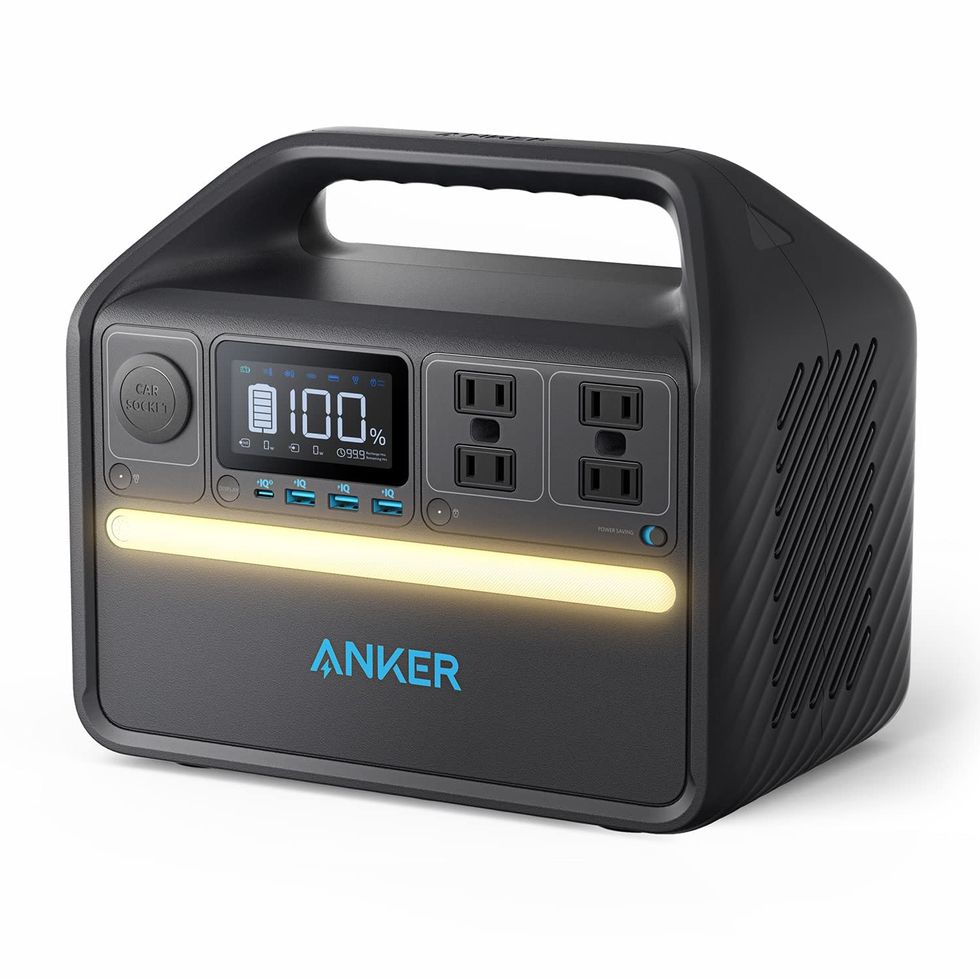
Anker knows a thing or two about making battery packs. After all, the company has been doing it for over a decade, with a vast array of portable USB power banks designed for smartphones. Anker has stepped up its game, however, and is now manufacturing much higher-capacity power stations, including its PowerHouse 535. This compact unit has a built-in handle and packs in 512 watt-hours worth of power.
It can power devices up to 500 watts (750-W surge), uses lithium-iron-phosphate (LFP) chemistry for a longer lifespan compared to lithium-ion (Li-ion), and comes with a five-year warranty.
The PowerHouse 535 offers one DC charging port, four AC wall plugs, three USB-A ports, and a USB-C port (60-W max). The 512-Wh capacity (160,000 milliampere-hours) should be enough to charge an iPhone 14 Pro Max up to 30 times or power a standard electric cooler for between 10 and 16 hours, depending on ambient temperatures.
The unit can charge at up to 120 watts via the included DC adapter, which would bring it to 80 percent charge in two and a half hours (and roughly four hours to 100 percent charge). It can also be charged at up to 60 watts via the USB-C input in case you don't want to have to worry about carrying another charger around.
This is a great option if you're out tailgating, headed to the beach for the day, or simply want a bit of added security in the event of power loss at home.
| Dimensions (L/W/H) | 11.5/9.9/7.4 in |
|---|---|
| Weight | 16.8 lb |
| Capacity | 512 Wh |
The EcoFlow Delta 3 Ultra Plus is EcoFlow's latest 3-kWh (3072Wh) portable backup built for real outages, with 3600-W output (7200-W surge). It features an industry-first Smart Output Priority that lets you assign two AC and one DC circuit so nonessentials shed automatically at a set threshold, while important things like the fridge and Wi-Fi stay on as the battery dwindles.
It recharges fast, going from zero to 80 percent in as little as 48 minutes via dual solar and generator charging, and under load, it runs under 25 decibels, making it nearly silent alongside other background noise. The unit's full-tab lithium-iron-phosphate cells and strict cell matching is designed to deliver 10 years of dependable use. The unit is rather beefy, but its built-in wheels and retractable handle keep it portable.
If you need extra power, additional add-on battery packs can bring the unit's full capacity up to 11 kWh, which should be more than enough for even the most demanding households.
Features at a Glance
| Dimensions (L/W/H) | 24.1/12.9/15.6 in |
|---|

The Anker SOLIX C1000 Gen2 packs a solid punch for its size, offering 1024 Wh of capacity and a 2000-W output, which is enough to run most household essentials or power tools without blinking. It recharges quickly (fully juiced in just 49 minutes using a 1540-W wall input) and includes a UPS (uninterruptible power supply) mode with a 10-ms switchover time, which is a must-have for keeping sensitive gear like CPAP machines and Wi-Fi routers online during outages.
Anker's use of lithium-iron-phosphate (LiFePO4) batteries gives the C1000 Gen2 a long service life (rated for 4000 cycles) so it's built to last even with regular use. And despite the high capacity, the unit stays relatively compact and manageable at 24.9 pounds. As for input/output, it offers five AC outlets, two high-wattage USB-C ports, and a 12-volt car socket, giving it plenty of flexibility for home backup or weekend trips.
That said, there's no option for battery expansion, so what you buy is what you get. Still, for users who need reliable power with fast recharge times in a streamlined form factor, the SOLIX C1000 Gen2 makes a strong case for itself. It's efficient and durable, and it doesn't try to do too much beyond its well-defined lane.
Features at a Glance
| Dimensions (L/W/H) | 15.1/8.2/9.6 in |
|---|---|
| Weight | 24.9 lb |
| Capacity | 1024 Wh |
The Jackery Explorer 3000 Pro (the core unit of the HomePower 3000 kit) solves the mobility issues of large generators with a brilliant "luggage-style" design. Packing a massive 3024-Wh capacity and 3000-W output into a 64.0-lb unit, it features a telescoping handle and sturdy wheels that make it exceptionally easy to maneuver. It offers enough wattage to run 99 percent of household appliances, including RV air conditioners, making it the ultimate solution for high-demand users on the go.
To achieve the lighter weight, Jackery uses nickel-manganese-cobalt battery chemistry rather than the heavier LiFePO4 standard found in some rivals. While this results in a shorter lifespan of 2000 cycles, the trade-off yields superior portability and relatively quiet operation (as low as 30 decibels). Combined with rapid 2.4-hour wall-charging, it is the clear choice for campers and RVers who prioritize genuine mobility over stationary longevity.
Features at a Glance
| Dimensions (L/W/H) | 16.4/12.8/12.0 in |
|---|---|
| Weight | 59.5 lb |
The Bluetti Apex 300 is a high-capacity, dual-voltage portable power station designed for everything from emergency home backup to RV and off-grid use. With 2765 Wh of storage and a 3840-W output, it supports 120/240-volt appliances and can run in parallel with additional units to scale up to 11,520 W and nearly 58 kWh with Bluetti's optional B300K backup batteries. Notably, it's the first in its category to feature a 50-amp/12,000-W bypass capability and a true 0-ms uninterruptible power supply, making it capable of powering demanding devices without interruption.
The system is also modular, with hot-swappable components and compatibility with Bluetti's broader ecosystem of batteries and accessories. While the Apex 300 brings a level of complexity and cost that might exceed the needs of casual users, it offers robust capabilities for those seeking a long-term, scalable energy solution.
| Dimensions (L/W/H) | 20.7/12.9/12.6 in |
|---|---|
| Weight | 66.1 lb |
| Capacity | 11059 Wh |
The Jackery Explorer 500 has a 512-Wh capacity with a 500-W maximum output (1000-W surge). As is a trend you'll see throughout this list at the various power capacities, this unit looks almost identical to the similar-capacity Anker PowerHouse 535, although the Explorer 500 does differ in a few key ways.
Most notably, the Jackery unit has only one AC outlet (with a pure sine inverter). It also has a standard DC charging port, as well as two DC barrel ports that can be used with an array of various DC connectors (sold separately) to power more obscure devices without the need for a large DC adapter. The Explorer 550 also has three USB-A ports (no USB-C).
One of the more distinctive features of this power station (at least at this capacity) is its ability to be charged not only over your standard AC wall outlet and DC car plug but also via solar. The Explorer 500 has a built-in maximum-power-point-tracking (MPPT) controller, which allows it to be charged via a solar panel at up to 100 W. However, Jackery uses a rather obscure DC barrel port for its solar panels, so you'll either have to go with one of the company's SolarSaga solar panels or purchase an MC4-to-DC adapter if you plan to use the more standard connection other solar-panel manufacturers use.
While the solar-charging component might get complicated if you plan to use non-Jackery solar panels, having the option to charge the Explorer 550 even if you don't have direct access to power is a nice advantage.
| Dimensions (L/W/H) | 11.8/7.6/9.2 in |
|---|---|
| Weight | 13.3 lb |
| Capacity | 512 Wh |
The Anker SOLIX F3000 is Anker's latest power station, packing an impressive amount of capacity into a smaller, more streamlined frame than its predecessors. In testing, its 3072-Wh lithium battery easily powered a full-size fridge for over 40 hours and supported other household essentials without issue. The dual-voltage 120/240-volt output adds rare flexibility in a unit this size.
Recharging is genuinely fast: Combine solar and generator input, and you can top it off at up to 6000 W, making it one of the quickest units we've used. At nearly 91.5 pounds, it's not exactly grab-and-go, but its build quality is solid, and the interface is straightforward. With support for expansion up to 24 kWh, it's more than ready for extended off-grid use or serious emergency prep.
| Dimensions | 25.6/11.8/14.8 in |
|---|---|
| Weight | 91.5 lb |
| Capacity | 3072 Wh |
The EcoFlow Delta 2 is a 1024-Wh power station built around an lithium-iron-phosphate battery. It supports appliances and devices that pull up to 1800 W (2200-W surge) and has an impressive array of ports to ensure nearly every device imaginable can be powered on the go.
Specifically, the Delta 2 features six standard AC wall outlets, a DC car plug (12 volts), two 5.5-mm DC barrel plugs (DC5521), two USB-C (100-W max) ports, two USB-A fast-charge (18-W max) ports, and two standard USB-A (12-W max) ports. For charging the unit, you can use the included AC wall adapter, which can charge the device from zero to 100 percent in just 80 minutes at 1200 watts, or use the XT-60 DC input for charging the unit via solar panels or a DC car charger.
The unit features a partially colored LCD display that shows the current input/output status, and it can be paired with a smartphone for wireless monitoring via the company's Android and iOS apps. If you'd like a little more power, you can also purchase an expansion battery to double the capacity to 2048 Wh, but at that range, it almost makes more sense to go with a 2000-Wh unit, such as those listed below.
That said, the EcoFlow Delta 2 is a solid 1024-Wh unit that's rated to hold 80 percent of its battery capacity even after more than 3000 charging cycles, ensuring your road trips, tailgating parties, and overlanding adventures are backed with a bit of off-grid power.
| Dimensions (L/W/H) | 15.7/11.1/8.3 in |
|---|---|
| Weight | 27.0 lb |
| Capacity | 1024 Wh |

If you're looking to power high-wattage tools or simply pack as much power as possible into a portable unit, you're going to want to look for power stations such as Anker's Solix F200 (formerly called the PowerHouse 767). This unit features a 2048-Wh-capacity lithium-iron-phosphate battery pack with the ability to double it to 4096 Wh with an optional expansion battery.
The Solix F2000 can continuously power tools and devices that pull up to 2400 W via a pure sine wave inverter. For plugging in devices, Anker includes four AC wall outlets, two DC car plugs, three USB-C ports (all up to 100 watts), two USB-A ports, and a TT-30 plug for powering RVs, trailers, or other dwellings with the proper cable. Between these 12 ports, you should have more than enough space to power all your devices, whether you're tailgating at your home team's game or miles off the beaten path on your latest overlanding trip.
The Solix F2000 can recharge at up to 1440 watts via AC power and up to 1000 watts via DC power when used with solar panels. Anker opted to go with an XT-60 connection for its DC power input, making it easy to charge the unit with the company's line of solar panels (or third-party solar panels) so long as you have a way to get the power to a male XT-60 connector. The DC XT-60 connection can also be used to charge the device via the included DC car charger, but it'll top out at 120 W due to the limitations of most vehicles.
Other nice features of this unit include the pop-out luggage-style handle and accompanying wheels that make it easy to move around as needed, as well as the built-in light bar and LCD display. The unit also has Bluetooth connectivity that works alongside Anker's app to allow you to update the unit's firmware, keep an eye on internal temperatures, check on input/output statuses, and even remotely turn on and off different plugs on the unit.The Anker Solix F2000 can be purchased on its own or in various bundles that include Anker's 200-W solar panels and/or the expansion battery that doubles the capacity of the unit.
| Dimensions (L/W/H) | 20.7/9.8/15.6 in |
|---|---|
| Weight | 67.3 lb |
| Capacity | 2048 Wh |
FAQs

Will these power stations run my camping equipment and RV appliances?
Depending on their capacity and output, many power stations can run camping gear and RV appliances. Some of the larger units even offer a TT-30 plug, the standard most RV models use. Always check the power requirements of your equipment against the station's specifications.
How useful are power stations during long road trips or off-grid adventures?
Extremely. These units can power essential devices, provide emergency backup, and even assist in jump-starting vehicles with the appropriate attachments, making them a road-trip essential.
How long does it typically take to fully charge a power station?
Charging times vary by model and power source, but most stations take between two and six hours. AC charging is typically the fastest option, although some of the units above can actually charge faster with solar panels. You can charge all of these units via your car's DC plug, but considering those connections typically top out at 120 watts, they're best used for maintaining the battery rather than charging from dead.
Do power stations generate noise when in use?
Most power stations are essentially silent, but most do have built-in fans that activate during high usage or while charging. These fans are typically very quiet, though, and some units even have "quiet charging" modes that charge at a slower rate, which negates the need for the fan to run.
Is it possible to chain multiple power stations together for more energy?
Select models, including some mentioned above, allow for daisy-chaining or connecting to expansion batteries, effectively increasing their capacity. Check the manufacturer's specifications for compatibility.
Are there any risks of overloading the power station?
Technically, yes. Exceeding a station's maximum output can cause overheating or damage. However, every unit we've highlighted here includes built-in protections to minimize the risk of anything serious happening. That said, always ensure your devices' combined power draw is within the station's limit.
Can power stations power high-consumption devices like electric grills or heaters?
While some high-capacity stations might handle brief usage from these devices, continuous use of high-draw appliances could quickly deplete the battery or risk overload. Always compare the devices' wattage with the power station's rated output.
Why Trust Us
The Gear Team helps readers make informed purchasing choices about automotive gear, tools, and accessories through hands-on product evaluations and comprehensive testing. Car and Driver's renowned testing standards mandate that we use all products we feature, and that our findings and recommendations are based on personal experience and knowledge—not hype.
The Gear Team's product selection and gear picks are editorially independent; Car and Driver has a strict policy against accepting payment for placement in articles. We won't claim to have tested something we haven't, and we'll never recommend a product we wouldn't buy ourselves. We've evaluated dozens of product categories, like floor mats, portable jump starters, and dash cams.
Visit our Tested & Trusted page to see the very best in automotive gear, and learn more about our testing process here.
Gannon Burgett loves cameras, cars, and coffee: a perfect combination for his Hearst Autos work. His byline has appeared in USA Today, Gizmodo, TechCrunch, Digital Trends, the Detroit Free Press, and more.

Road-Trip Essentials Checklist

Hit the Slopes with These Ski and Snowboard Racks

Best Backup Cameras of 2026, Tested

Never Get Stranded with Our Favorite Jump Starter


