Our car experts choose every product we feature. We may earn money from the links on this page.
Tested: Best Car Power Inverters
If you're needing other plug options for using gadgets on the go, a power inverter is essential. We tested a few of them to find the best.
 Tested by Katherine Keeler and Gannon Burgett
This article was updated in February 2026 with new information.
Whether you're taking a road trip or on your morning commute, the list of plug-in gadgets for your car is ever-growing. Have to juice up your laptop on the way to the office? Need a charging port for that. What about that tire inflator when you get a low tire pressure warning? Hmm, gotta find a plug for that, too.
Best Power Inverters
- Best Value: Energizer 500W
- Best Rugged: DeWalt 140W
- Best Budget: Bestek 300W
More Car Tech Tested: Best Portable Carplay Units | Best Radar Detectors | Best Dash Cams
Thankfully, auto manufacturers have heard our pleas and are including multiple power ports in newer vehicles, including USB and USB-C, 12-volt traditional style, and even AC outlets. While this is nice, not all of us drive fancy new cars with all the bells and whistles, or your phone isn't compatible with the charging ports provided. Maybe you just want some extra plug space. Regardless of the scenario, using an inverter adds electrical ports to your vehicle for whatever you need to power.
To aid in your power inverter buying process, we put a few of the top-rated options to the test. We analyzed each inverter through a range of parameters; here's what we uncovered.
Best Car Power Inverters, Tested
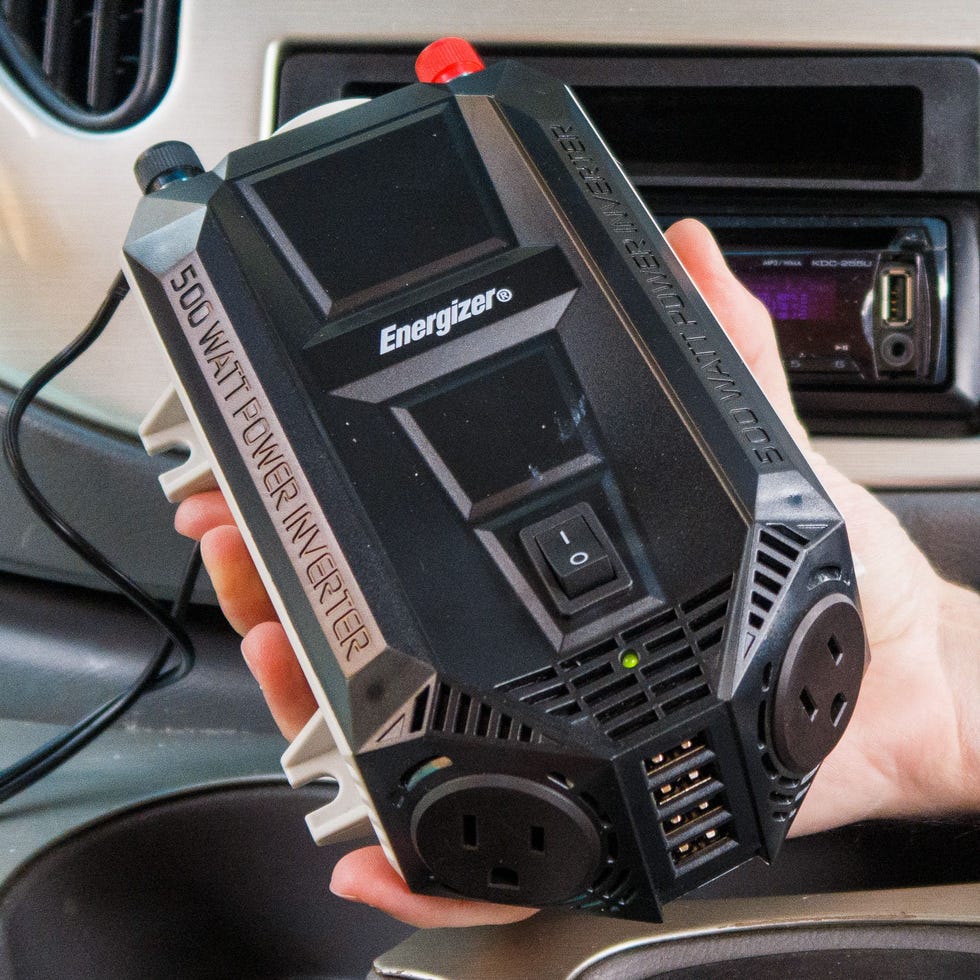
Energizer 500W Power Inverter
Pros
- Six different plug options
- Capable of 500W when connected to the battery

Cons
- AC plugs are at a strange angle
- No USB-C ports

If you need a power inverter for higher-draw devices, we recommend the Energizer 500W. With the ability to plug into your vehicle's cigarette-lighter port and connect directly to the battery, it offers a few more options.
There are four USB ports and two AC outlets to choose from, so there's room for everyone. In our device test, the Energizer was able to handle two iPhones, two iPads, and the battery charger, but blew the internal fuse when we tried to power on a blender.
To utilize the full 500-watt rating, you'll need to connect it directly to your vehicle's battery with the included alligator clamps. Because of the six plug options and internal protection, this is our pick for the Best Power Inverter for Higher-Draw Devices.
| Power Source | 12-volt cigarette-lighter port; alligator clamps for battery connection |
|---|---|
| Number of Plugs | Four 2.4A USB ports; Two 120V AC outlets |
| Weight | 1.69 lb |
| Cord Length | 32.5 in |
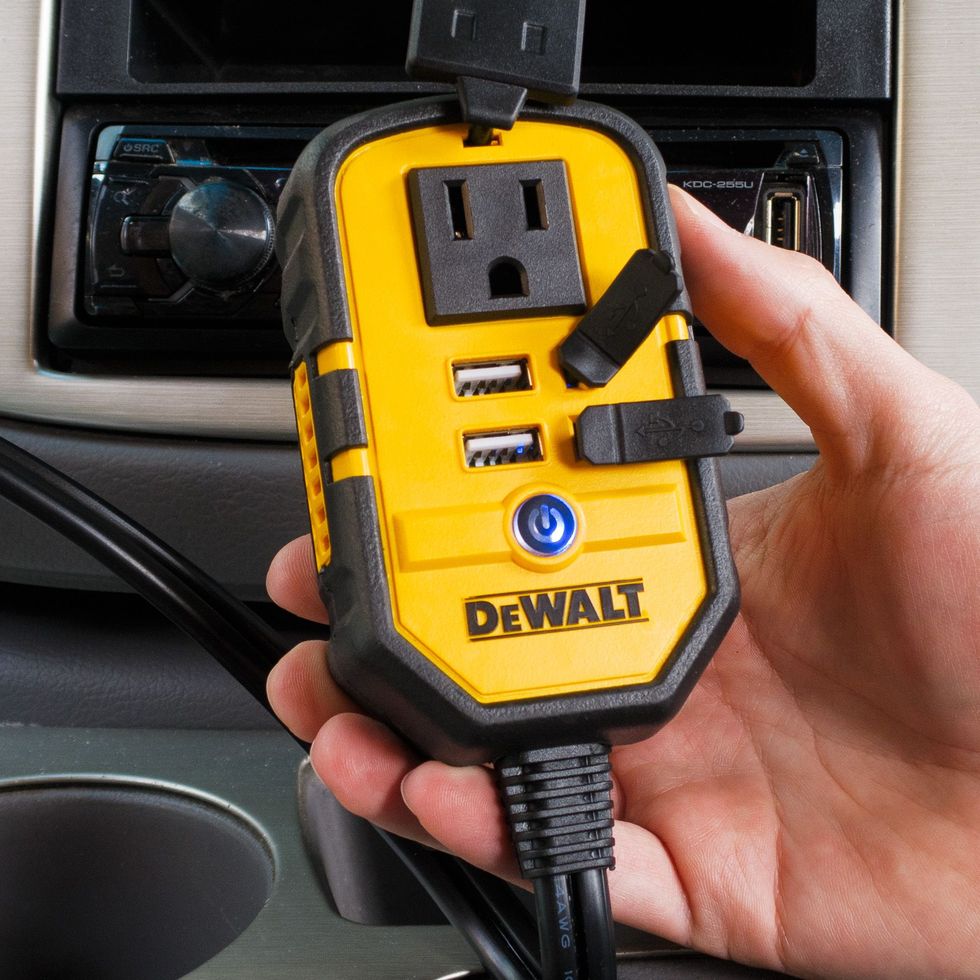
DeWalt 140W Power Inverter
Pros
- Rugged construction
- Status light that doubles as a fault indicator
Cons
- Only three plug options
- No USB-C ports
If you just need a couple of charging ports, the DeWalt 140W is a great option. The inverter is built with durability in mind, featuring rubber grips and a thick power cord. This thing isn't going to break any time soon.
There's also a handy status light that burns blue when power is being supplied and red when a fault is detected. In our device test, the DeWalt survived a phone, iPad, and blender, but blew the internal fuse with the hair dryer.
We loved its rugged construction and the status light but wish it had more options for plug-ins. Regardless, it's an honorable mention and a fine choice.
| Power Source | 12-volt cigarette-lighter port |
|---|---|
| Number of Plugs | Two 3.1A USB ports; One 120V AC outlet |
| Weight | 0.75 lb |
| Cord Length | 35.5 in |
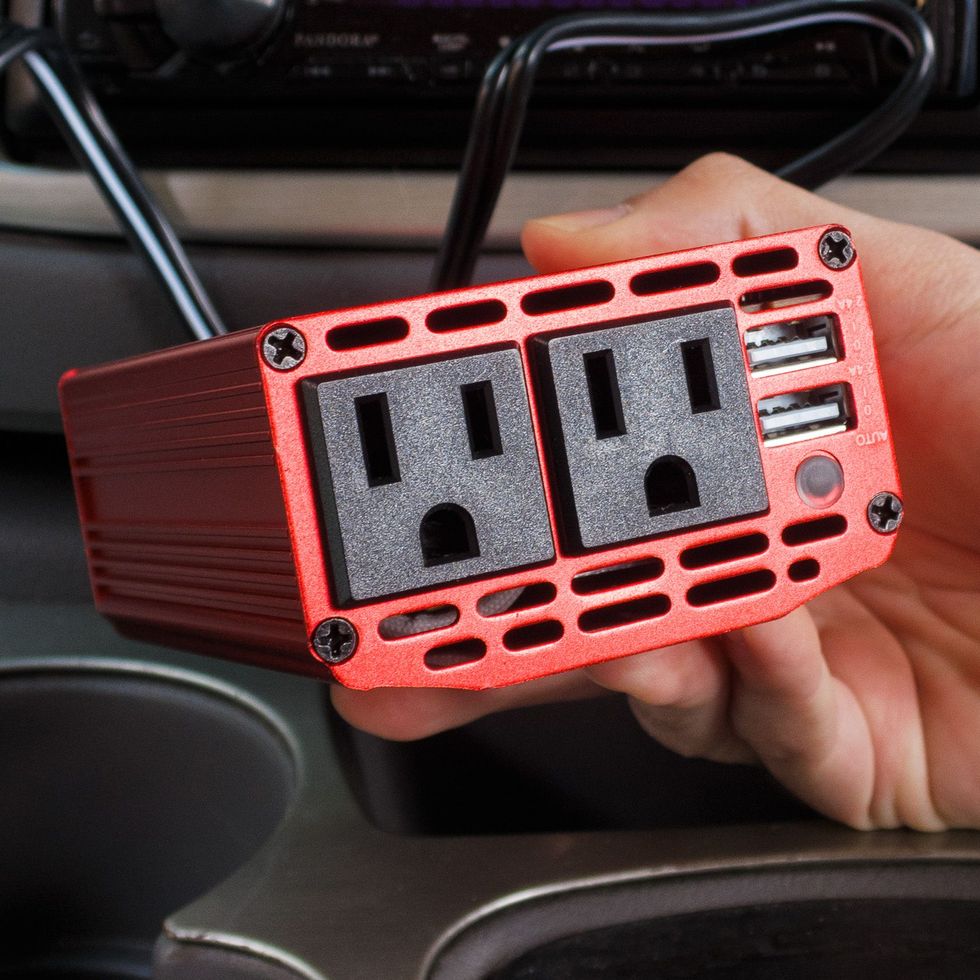
Bestek 300W Power Inverter

Pros
- The two AC outlets are handy
- Looks great
Cons
- 40-amp internal fuse is way too high—can easily pop your vehicle's fuse
- No USB-C ports
While the Bestek 300W looks slick, it did fail our device test. It was able to power an iPhone, iPad, battery charger, and hair dryer for 5 seconds—until it popped our van's 20-amp fuse.
Is this the Bestek's fault? Not necessarily. It's rated for 300W (our van's circuit was rated for 240W) and goes to show that you need to check your vehicle's capacity if you want to avoid replacing a fuse all the time. Bestek says the internal fuse is rated at 40 amps—which seems really high compared to our vehicle's 20-amp fuse.
It's a solid power inverter that looks great, but be careful—it will pop your vehicle's fuse if too much load is demanded.
| Power Source | 12-volt cigarette-lighter port |
|---|---|
| Number of Plugs | One 0-2.4A USB port; One 2.4A USB port; Two 120V AC outlets |
| Weight | 0.91 lb |
| Cord Length | 32.5 in |
How We Tested Power Inverters

We tested power inverters as practically as we could, plugging in common devices to see how much juice each would deliver. We tried a variety of electronic accessories ranging from iPad chargers to a hair dryer and a blender. Gear Team Tester Katherine lent her dependable 2001 Ford E-150—affectionately known as Rhonda—for this test, and it was a true vehicular champ. To get a sense of which power inverter works best for any given situation, we tested the following parameters:
- Supported devices
- Cord length
- Weight
- Number of ports
- Surge protection results
- Usability
We assembled our notes and testing data to decide which power inverters were the best for certain situations. Our data contained both objective and subjective observations and, surprisingly, none of these units had the smaller USB-C ports that are used by a lot of the latest electronic devices.
For our main supported devices test, we plugged in various gizmos starting at the lowest wattage and working our way up. Our first devices were iPhone and iPad chargers, then we progressed through a Milwaukee battery charger, a blender, a dual-action polisher, and finally, a hair dryer. Here's the power draw for each device we measured with a Kill-A-Watt:
- iPhone charger: 14 watts
- iPad charger: 14 watts
- Milwaukee battery charger: 90 watts
- Blender: 290 watts at peak, 125 watts continuous
- Polisher: 260 watts at peak
- Hair Dryer: 547 watts at peak
We stacked these devices in ascending watt-usage order until the internal power inverter fuse popped or, in two cases, the 20-amp vehicle fuse blew. We then took notes on how much each inverter could take and which fuse blew first for our surge protection test.
We counted the number of USB and AC ports each inverter had, along with the weight via a mail scale. We then measured the power-cord length from the base of the inverter to the end of the plug. And finally, we took notes on the usability of each inverter.
Things to Consider When Shopping for a Power Inverter

There are a whole bunch of different power inverters out there, each with different wattage ratings. Which one do you get? To make your power-inverter party run smoothly, here are some things to consider.
Wattage rating: This might be the most important factor when it comes to buying a power inverter. All it takes is some simple math to know if an inverter can handle what you want to plug in. Multiply the voltage (5 volts for USB, 12 volts for cigarette lighter, and 120 volts for an AC) by the amperage of your device to get the wattage. Compare that to the wattage rating of your power inverter, and that'll tell you if it can handle the draw.
Another thing to check is your vehicle's fuse rating for the 12-volt port—the fuse on our test van was 20 amps. By doing the math, that circuit can handle 240 watts. Any draw above that will pop the fuse.
The easy solution is to just install a larger fuse, right? Wrong. That entire circuit, including the size of the wiring, is rated for no more than 20 amps. If you demand more, you run the risk of starting an electrical fire. If you need to run a high-wattage device, consider getting a power inverter that hooks directly to the vehicle battery—which can handle a lot more juice than the 12-volt cigarette lighter.
Number of outlets: Check to see how many USB and AC outlets the power inverter offers. They're all a bit different, and it's important to double-check that an inverter has the ability to handle what you need.
Power-cord length: If you need devices to reach the inverter from the back seat, it's important to take the power-cord length into consideration. There's nothing worse than taut cords reaching from every seat like a spider's web.
Heat: These little devices work hard to put out the power you need. A side effect of this is heat, and the devices can get piping hot if powered on for long periods of time. Keep that in mind, and make sure it doesn't melt delicate surfaces or those road-trip chocolate chip cookies.
FAQs

What does a power inverter do?
In short, a power inverter changes 12-volt direct current (DC) from your vehicle's cigarette-lighter port to 120-volt alternating current (AC). The devices you plug into wall outlets use AC, although some of them, such as phone chargers, convert that back to DC.
Do power inverters drain your vehicle's battery?
Yes, and it's important to keep an eye on the battery charge level or keep the vehicle running. Some power inverters feature an audible "low-power" beep or shut off when low power is sensed. If you're looking at getting a larger power inverter that runs off the battery, it's important to verify your vehicle's electrical system can handle the strain. Consulting a professional is a safe bet.
How long will it take a power inverter to drain a car battery?
If you use a smaller power inverter for a low draw like charging your laptop, you can expect to get between 30 and 60 minutes of power before your vehicle's battery dies. This, of course, depends on the draw and state of the battery. It's best just to leave the vehicle running.
What kinds of things can I use in a power inverter?
It depends on the wattage rating of said power inverter, but typical devices include phone and laptop chargers, small televisions, and gaming systems. Larger power inverters are capable of powering just about anything—your vehicle's electrical system needs to be significantly upgraded, though.
What do you do if the power inverter's fuse blows?
Most power inverters come with some extra fuses, and they're generally easy enough to replace. Simply unscrew the end of the 12-volt plug adapter, remove the cylindrical fuse, drop a new one in, retighten the end, and you're good to go.
What do you do if the vehicle's fuse blows?
If your vehicle's 12-volt cigarette-lighter fuse blows, check the owner's manual for the fuse locations—there are typically multiple fuse boxes on any given model. Find the fuse for that circuit, and pull out the old fuse with a pair of needle-nose pliers. Hold it up to the light and look for a break in the metal portion. It might even look burnt. Replace it with a fuse of the same amperage rating, and you're good to go.
Why Trust Us?

The Gear Team helps readers make informed purchasing choices about automotive gear, tools, and accessories through hands-on product evaluations and comprehensive testing. Car and Driver’s renowned testing standards mandate that we use all products we feature, and that our findings and recommendations are based on personal experience and knowledge—not hype.
The Gear Team’s product selection and gear picks are editorially independent; Car and Driver has a strict policy against accepting payment for placement in articles. We won’t claim to have tested something we haven't, and we’ll never recommend a product we wouldn't buy ourselves.
We’ve evaluated dozens of product categories, like interior cleaners, tire inflators, and tonneau covers. Visit our Tested & Trusted page to see the very best in automotive gear, and learn more about our testing process here.
Collin Morgan is a Commerce Editor at Hearst Autos, where he presents the best gear for your automotive endeavors. He has been a technician in the trenches of Midwestern automotive repair, explored the automotive shrines in central Italy, and now enjoys making slow cars go fast around various Michigan racetracks.
Katherine Keeler is Associate Testing Editor at Hearst Autos. By day she evaluates tools for your enjoyment; by night, she Frankensteins her ever-changing fleet of rustbucket oddities back to repair. Her dream is to open a roadside attraction where the public can view, drive, and learn repairs at her emporium of curious cars.
Gannon Burgett loves cameras, cars, and coffee: a perfect combination for his Hearst Autos work. His byline has appeared in USA Today, Gizmodo, TechCrunch, Digital Trends, the Detroit Free Press, and more.

Best Backup Cameras of 2026, Tested

Tested: Best Steering-Wheel Locks for 2026

Best Car Ramps for 2026, Tested

Tested: Best Garage Shelving of 2026


